Honor Magic8 Pro review
Extra-bright and capable 6.71" OLED display
The Magic8 Pro is equipped with a 6.71" display that's almost looking like a downgrade compared to the Magic7 Pro's - after all, the old one was 6.8" in diagonal. Countering this inconsequential minute difference are a couple of more similarly small improvements - in peak brightness, mostly. Ultimately, it's a top-class display.

The resolution is 1,280x2,800px, which is a little short of 1440p, but still plenty sharp - pixel density works out to 453ppi. The LTPO OLED panel has an adaptive refresh rate up to 120Hz, there's up to 4320Hz PWM for low-brightness dimming, as well as DC dimming in the higher brightness regions.
There are all sorts of other eye relief features too, grouped under their own settings menu item called Honor Eye Comfort Display. You can customize brightness, contrast, and color reproduction by taking an onscreen test, there's blue light filtering and an ambient light-based color tone adjustment, and there's even a defocus feature that simulates you're looking at distant images. Semi-related, a Motion sickness relief feature is also part of the package.
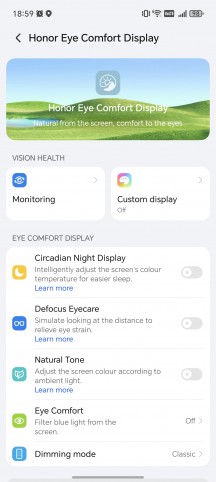
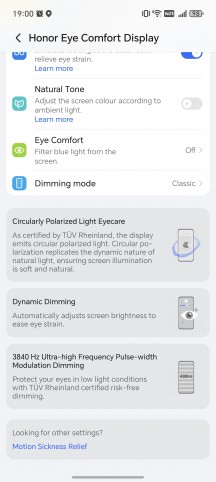
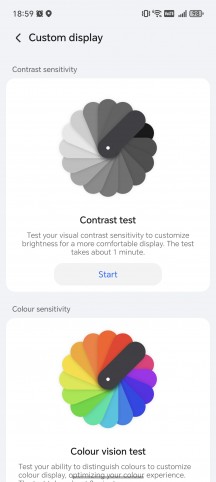
Honor Eye Comfort Display
In our brightness testing, we measured some pretty remarkable numbers on the Magic8 Pro. The 856nits of manual brightness is towards the top of the class (Pixels excluded), but it's the brightness you get with the auto enabled that is truly impressive - we got upwards of 5,000nits for a 10% patch of white (and a properly great 1,837nits for 75% white coverage too). The minimum brightness we measured was around 1nit, which is also about as good as it gets.
Max display brightness test
White test pattern (nits)
- Manual (75% fill)
- Auto (75% fill)
- Peak Auto (10% fill)
 Pixel 10 Pro XL
 vivo X300 Pro
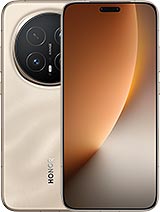 Honor Magic8 Pro
 Xiaomi 15 Ultra
 Huawei Pura 80 Ultra
 Xiaomi 17 Pro Max
 iPhone 17 Pro Max
Refresh rate
The Magic8 Pro supports refresh rates in the 1-120Hz range, with granular adaptive behavior based on content and user interaction. It dials down to 1Hz when idling and showing a static image, shoots up to 120Hz when you touch the display, and picks something in between if you have a video playing, for example. You can set a global cap at 60Hz by choosing the Standard mode, or leave it in Dynamic and let it do its thing. The third mode, High, is like Dynamic (so 120Hz maximum and a fully adaptive behavior), but you can set 60Hz limits on a per-app basis.

The Magic allows high frame rate gaming too, with both 3D titles and arcade games going over 60Hz/60fps.
Streaming and HDR
You get support for all major HDR standards on the Magic8 Pro - HDR10, HDR10+, Dolby Vision, HDR Vivid, you name it. The Netflix app has you covered for content created with any of the first three and will happily stream in FullHD too, thanks to the Widevine L1 compliance. HDR also works in YouTube without incident, including in PiP mode.

By now it should go without saying, but we'll say it anyway - metadata-enhanced Ultra HDR photos get the expected highlight boost in the two preinstalled gallery apps (the in-house one, and Google Photos) and in Google Chrome. That works for photos shot on the phone itself as well as on other standard-compliant phones.
Honor Magic8 Pro battery life
The Magic8 Pro's battery capacity varies by region. The China version gets the largest capacity, at 7,200mAh, while European Magics (like the version we're reviewing) are capped at 6,270mAh.
There's another version that's for markets outside of China and Europe, which should be 7,100mAh. Regardless of locale, the battery uses silicon carbon anode tech.

Honor Magic8 Pro: global variant (left) and EU variant (right)
The Euro version of the Magic8 Pro that we have here aced our tests, even though it's the lowest specced of the three. We got an Active Use Score of 19:07h, with excellent marks in the individual tests. Admittedly, the Oppo Find X9 Pro is still a little bit better (7,500mAh is a lot of battery), but the Magic8 Pro is miles ahead of other major competitors and a significant step up from the previous generation.
Our new Active Use Score is an estimate of how long the battery will last if you use the device with a mix of all four test activities. You can adjust the calculation based on your usage pattern using the sliders below. You can read about our current battery life testing procedure here. For a comprehensive list of all tested devices so far, head this way.
Charging speed
The Magic8 Pro, in global form, is rated for 100W charging whether using a proprietary charger or a USB Power Delivery one, while the Chinese version's specs extend the proprietary capability to 120W. We didn't have a charger come with our review unit, but we did dig up a 100W Honor SuperCharge adapter we've kept from previous models, so we tested with that one. We also tried a few aftermarket USB PD adapters for good measure.

Using the Honor 100W adapter, we got a brief peak of 73W when starting from just above empty, and it took us to 100% in 40 minutes, with the phone showing 81% at the half-hour mark. With a 100W USB Power Delivery brick the numbers were ever so slightly worse - negligibly so, we'd say (70W, 42min, 79%). A 67W adapter was ever so slightly behind still (50W, 46min, 76%).
Mind you, you'd be best off with a USB Power Delivery adapter that has PPS profiles extending to 20/21V, because the phone charges the fastest at 18V, while lesser adapters might limit it to 9V - with one such charger we were looking at 69% at the half-hour mark which is now almost a meaningful difference compared to the more capable alternatives.
Regardless of which of these chargers we used, there was a relatively lengthy process of trickle and not-so-trickle charging after reporting a 100% state - about 25 minutes, give or take.
With both of the 100W options you need to press a bubble on the screen when you plug in the charger to go into boost mode and squeeze the absolute maximum charging speed out of the phone. That option doesn't show up with the less powerful adapters.
Charging speed
- in 15 min
- in 30 min
- Time to full charge (from 0%)
vivo X300 Pro
Xiaomi 17 Pro Max
Honor Magic8 Pro
Huawei Pura 80 Ultra
Honor Magic8 Pro (USB PD)
 Galaxy S25 Ultra
 Sony Xperia 1 VII
The Magic8 Pro supports wireless charging and the company quotes an 80W maximum when using its in-house wireless charger. We didn't have one for testing, but we did try with a 25W Qi2-compliant third-party charger and got single-digit power readings at its input end, so unless you get Honor's charger, don't expect to use wireless charging for anything but overnight top ups. Reverse wireless charging is also supported.
As on the previous model, the Magic8 Pro offers a selection of features for helping to prolong the lifespan of its battery. When turned on, the Smart Battery Capacity feature stops charging a notch below the cell's actual full capacity. Safe charging, meanwhile, cuts off power once the battery is full and starts over when the level drops below 95% - ensuring you won't be constantly pumping electrons left and right if you have your phone plugged in for long periods of time. Additionally, you can have the phone charge up to 70%, 80% or 90% - can be useful if you keep it plugged in for days on end for some reason.
Speaker test
The Magic8 Pro has a stereo speaker setup that's a bit more special than what you can find on most other smartphones out there. It's got two symmetrical speakers - as in, identical in size and model, but not necessarily symmetrical in placement. They're listed as 1216 (so 12x16mm, which is on the large side) and employ an open cavity design - they're ported towards the inside of the phone and use its internal volume as a chamber to boost low-end response. There's also a dedicated third driver (a relatively tiny one) for earpiece duty.
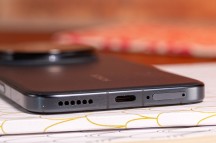
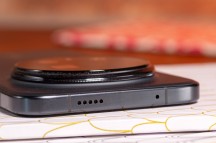
Bottom speaker • Top speaker • Earpiece
The Magic8 Pro earned an 'Excellent' score for loudness, a relatively rare feat even in the flagship segment. It marks an improvement in sound quality over the previous generation, delivering cleaner vocals and livelier treble, while also making bass more precise and well controlled. It's once again a standout performance overall that's unmatched by its rivals - the vivo X300 Pro and the Find X9 Pro aren't really on the same level and even an iPhone 17 Pro Max sounds small and distant in comparison.
Use the Playback controls to listen to the phone sample recordings (best use headphones). We measure the average loudness of the speakers in LUFS. A lower absolute value means a louder sound. A look at the frequency response chart will tell you how far off the ideal "0db" flat line is the reproduction of the bass, treble, and mid frequencies. You can add more phones to compare how they differ. The scores and ratings are not comparable with our older loudspeaker test. Learn more about how we test here.


Tip us
2.1m 180k
RSS
EV
Merch
Log in I forgot my password Sign up