Moto G7 family hands-on review
Software
The entire Moto G7 family comes with Android 9.0 Pie out of the box. The familiar Motorola customizations like Moto Display and Moto Actions are available as well.
One of the biggest changes Google introduced with Pie was gesture navigation but Motorola has had its own take on the pill since long before that with the Moto Z2. In its latest, slightly tweaked, iteration here it's called One-button nav and it's closer to Google's own implementation than the full-screen gestures of other makers. Basically, you swipe left on the bar to go Back, swipe right to quickly switch between the last two apps, swipe up for the task switcher, tap the bar to go Home, and tap-hold for Google Assistant.
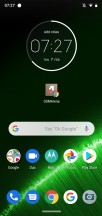
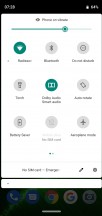


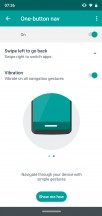
Moto G7 Plus user interface
Synthetic benchmarks
The Moto G7 Plus is powered by the Snapdragon 636 chipset, which was fairly popular in the midrange last year, but is a bit less exciting in 2019. Even so, it's an adequately powerful contemporary 14nm SoC with 8 Kryo 260 cores in its CPU, ticking as high as 1.8GHz.
The other three G7s rely on the more modest but still perfectly acceptable Snapdragon 632. Its octa-core Kryo 250 CPU (don't you just love Qualcomm nomeclature) is also clocked at up to 1.8, but is ever so slightly less brawny.
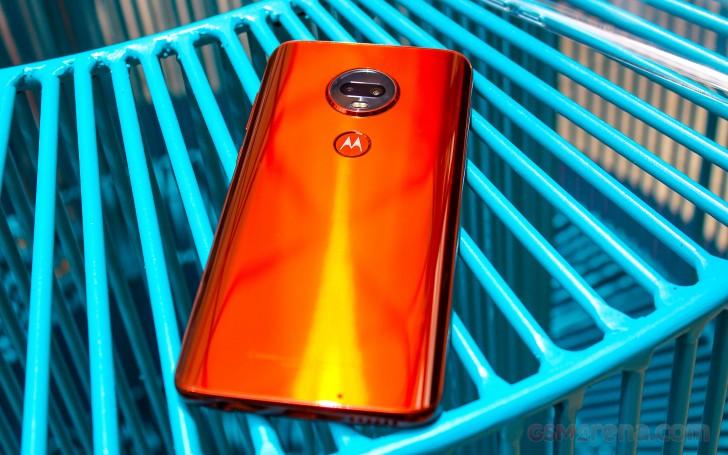
More significant difference can be observed in the graphics department where the Adreno 509 of the S636 is some 45-60% more powerful than the Adreno 506 in the S632. Logic dictates that the regular Moto G7 will be the least proud of its graphics benchmark scores of this quartet - it's got a high-res FullHD display and a relatively underpowered GPU. The Play and the Power models have lower-res 720p displays to go with their Adreno 506, which will give them an edge in real-life onscreen performance, while the high-res FullHD Moto G7 Plus has the upgraded Adreno 509 GPU.
In any case, we got to run some benchmarks on the top-of-the-line Moto G7 Plus and here come the results. For comparison purposes, we're including other S636 devices we've tested before, as well as the only other S632 smartphone that we've managed to get our hands on - the Asus Zenfone Max M2. Competing midrange chips are also in those charts.
GeekBench 4.1 (multi-core)
Higher is better
-
Realme U1
6004 -
Oppo RX17 Pro
5944 -
Xiaomi Mi 8 SE
5908 -
Oppo F9 (F9 Pro)
5673 -
Nokia 7.1
4975 -
BlackBerry KEY2 LE
4965 -
Xiaomi Redmi Note 6 Pro
4933 -
Nokia 6.1 Plus
4929 -
Motorola Moto G7 Plus
4927 -
ASUS ZenFone Max M2
4744 -
Samsung Galaxy A7 (2018)
4446 -
Motorola Moto G6 Plus
4160 -
Sony Xperia XA2 Plus
4144
GeekBench 4.1 (single-core)
Higher is better
-
Xiaomi Mi 8 SE
1890 -
Oppo RX17 Pro
1835 -
Realme U1
1567 -
Samsung Galaxy A7 (2018)
1524 -
Oppo F9 (F9 Pro)
1497 -
Nokia 7.1
1344 -
BlackBerry KEY2 LE
1343 -
Xiaomi Redmi Note 6 Pro
1342 -
Motorola Moto G7 Plus
1334 -
Nokia 6.1 Plus
1331 -
ASUS ZenFone Max M2
1257 -
Motorola Moto G6 Plus
882 -
Sony Xperia XA2 Plus
839
AnTuTu 7
Higher is better
-
Xiaomi Mi 8 SE
170218 -
Oppo RX17 Pro
154861 -
Realme U1
144436 -
Samsung Galaxy A7 (2018)
123883 -
Motorola Moto G7 Plus
117829 -
Nokia 7.1
117175 -
BlackBerry KEY2 LE
116764 -
Xiaomi Redmi Note 6 Pro
115605 -
Nokia 6.1 Plus
115571 -
ASUS ZenFone Max M2
103243 -
Motorola Moto G6 Plus
90263 -
Sony Xperia XA2 Plus
86374
GFX 3.0 Manhattan (1080p offscreen)
Higher is better
-
Xiaomi Mi 8 SE
33 -
Oppo RX17 Pro
32 -
Realme U1
22 -
Oppo F9 (F9 Pro)
20 -
Nokia 6.1 Plus
16 -
BlackBerry KEY2 LE
16 -
Nokia 7.1
16 -
Xiaomi Redmi Note 6 Pro
16 -
Motorola Moto G7 Plus
16 -
Samsung Galaxy A7 (2018)
16 -
Motorola Moto G6 Plus
14 -
Sony Xperia XA2 Plus
14 -
ASUS ZenFone Max M2
10
GFX 3.0 Manhattan (onscreen)
Higher is better
-
Xiaomi Mi 8 SE
30 -
Oppo RX17 Pro
28 -
Realme U1
20 -
ASUS ZenFone Max M2
19 -
BlackBerry KEY2 LE
18 -
Oppo F9 (F9 Pro)
18 -
Nokia 6.1 Plus
15 -
Nokia 7.1
15 -
Xiaomi Redmi Note 6 Pro
15 -
Motorola Moto G7 Plus
15 -
Samsung Galaxy A7 (2018)
15 -
Motorola Moto G6 Plus
13 -
Sony Xperia XA2 Plus
13
GFX 3.1 Manhattan (1080p offscreen)
Higher is better
-
Oppo RX17 Pro
23 -
Xiaomi Mi 8 SE
23 -
Realme U1
13 -
Oppo F9 (F9 Pro)
12 -
Nokia 6.1 Plus
10 -
Nokia 7.1
10 -
Xiaomi Redmi Note 6 Pro
10 -
Motorola Moto G7 Plus
10 -
Samsung Galaxy A7 (2018)
10 -
Motorola Moto G6 Plus
9.8 -
Sony Xperia XA2 Plus
9.5 -
ASUS ZenFone Max M2
6.9
GFX 3.1 Manhattan (onscreen)
Higher is better
-
Xiaomi Mi 8 SE
22 -
Oppo RX17 Pro
19 -
ASUS ZenFone Max M2
14 -
Realme U1
12 -
Oppo F9 (F9 Pro)
11 -
Nokia 7.1
9.7 -
Xiaomi Redmi Note 6 Pro
9.7 -
Motorola Moto G7 Plus
9.7 -
Nokia 6.1 Plus
9.6 -
Samsung Galaxy A7 (2018)
9.4 -
Motorola Moto G6 Plus
9.3 -
Sony Xperia XA2 Plus
9.1


Tip us
2.1m 180k
RSS
EV
Merch
Log in I forgot my password Sign up