Samsung Galaxy S26 Ultra review
No obvious changes, but one lens swap and no close-ups
The Galaxy S26 Ultra continues on the path of least resistance and keeps the changes in the camera department to a minimum. In fact, at a passing glance you'd be forgiven to think that it's all been straight up reused from the S25 Ultra (which, in turn, was barely different from the one before it), but there are, indeed, subtle tweaks.
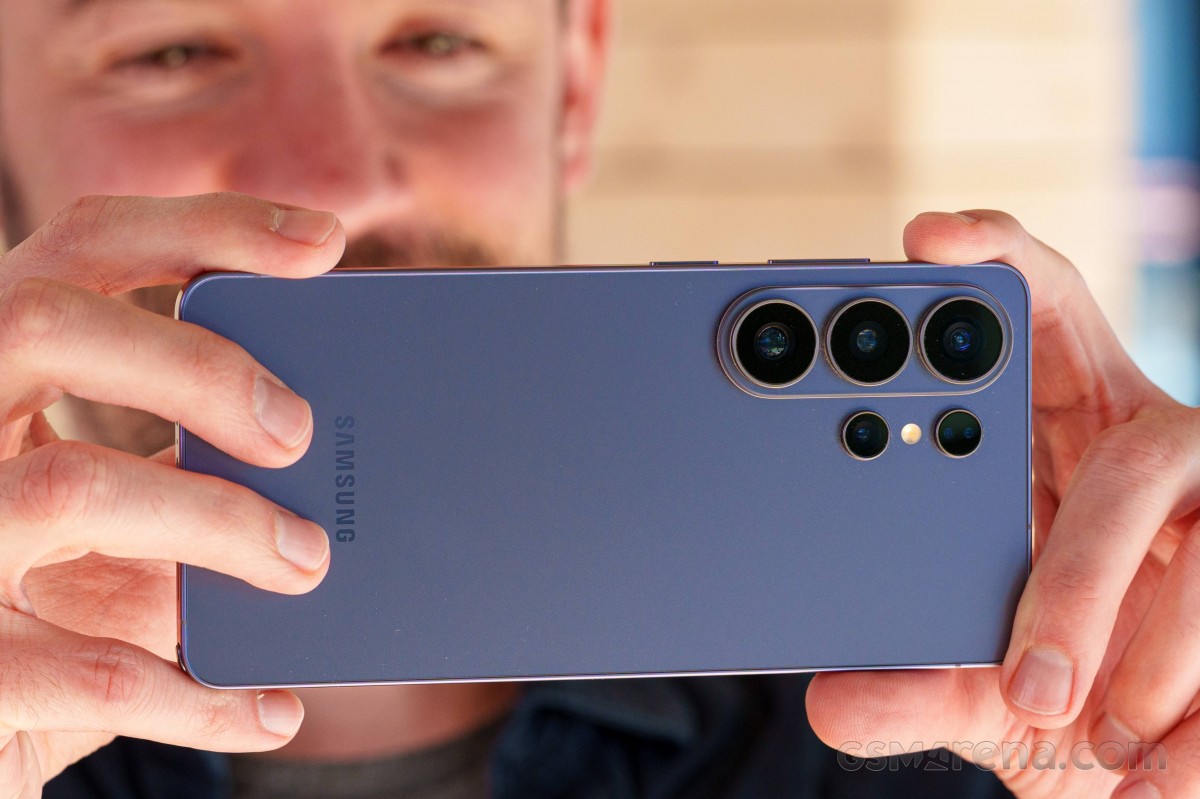
The main camera's sensor isn't one of them - the in-house HP2 200MP imager is unchanged and goes all the way back to the S23 Ultra from 2023 (it's 2026 now, by the way). Something has changed and that's the lens aperture - it's now an even brighter f/1.4 vs. the f/1.7 of the S25 Ultra, while keeping the same 23mm equivalent focal length.
Also wider is the aperture on the 5x telephoto camera - it's now f/2.9 as opposed to the f/3.4. But that's not the most significant change here. Samsung has apparently switched the periscope lens for a conventional one an ALoP one - our best guess is that the periscope module was too thick and it wouldn't fit in the slimmer body they were going for. And they could more easily make a conventional lens an ALoP assembly of the same focal length - so what if it sticks out more, the phone is technically thinner.
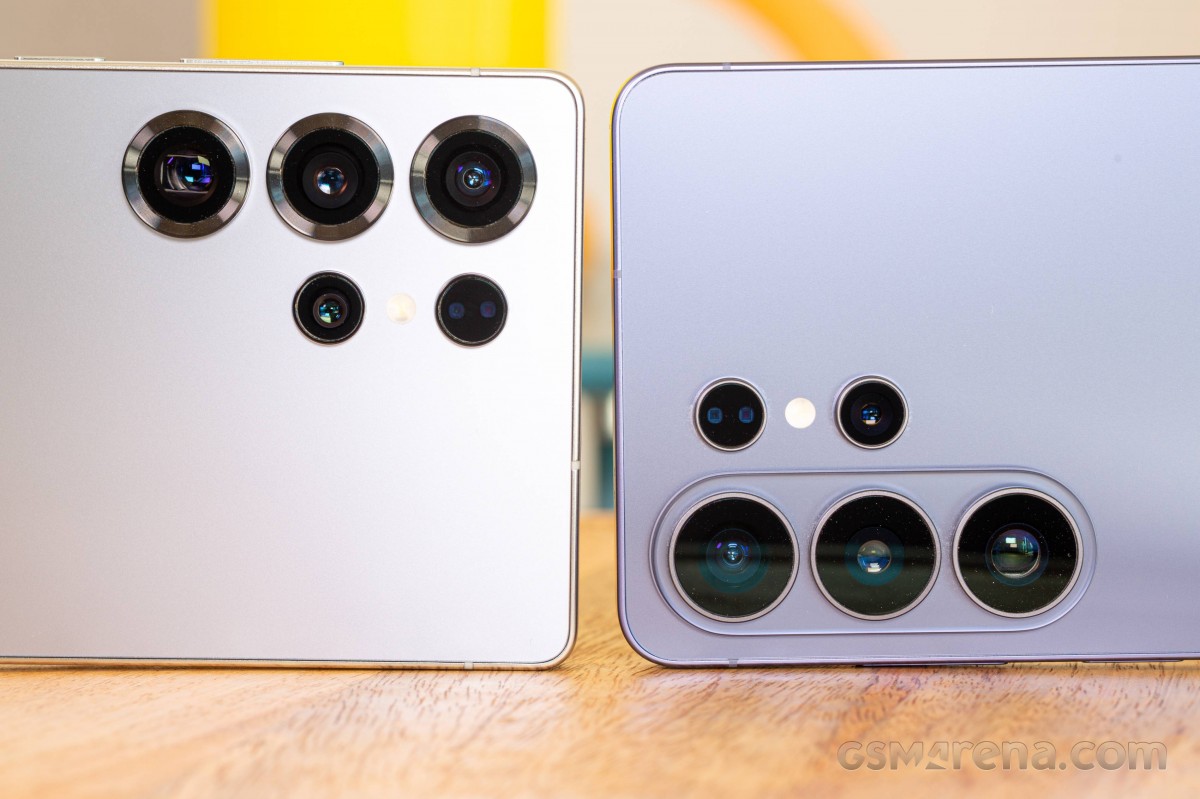 Galaxy S25 Ultra (left) next to S26 Ultra
They're not making it a point to draw attention to the change, but it shows in a couple of areas. One is minimum focusing distance - now 52cm as opposed to 26cm on the S25 Ultra. We like our telephoto closeups and they weren't ideal before - they're not getting any better now.
The other manifestation is the rendering of out-of-focus specular highlights (a.k.a. bokeh balls) - periscopes typically make them look like jagged-edge rectangles, while conventional lenses and this style of ALoP ones show a round shape that turns into cat's eyes the more you go off center. In a way, that could be viewed as a positive development.
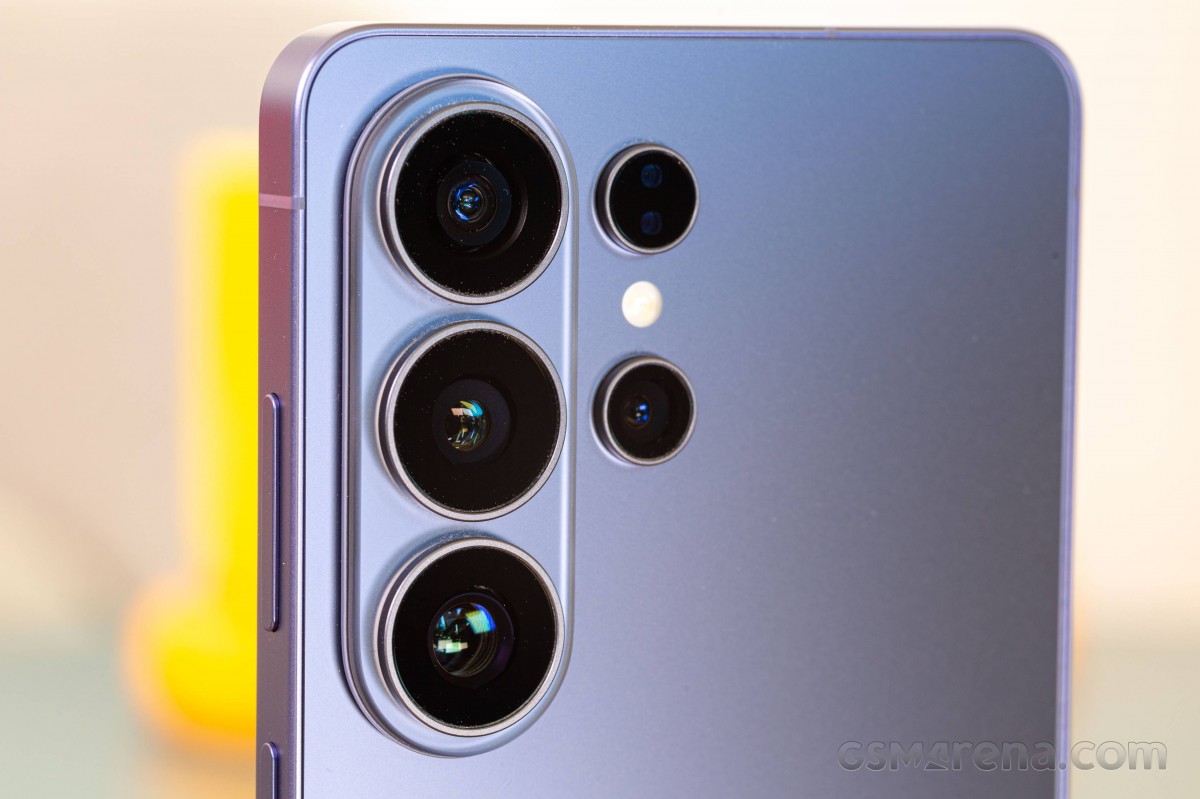
Moving back to downgrades, there's the 3x telephoto camera, which has now been treated to a smaller sensor. That is, this generation's Ultra model adopts the same size sensor that's been used on the non-Ultra S-series Galaxies since... what was it, the S22? That's innovation for you. For what it's worth, hardware apps do report a model name that's new to us, the 3LD. It's a 10MP sensor, but photos come out at 12MP anyway, because that's Samsung's way.
The ultrawide camera is the same as last year, which is when we got the switch from a 12MP regular RGB Bayer sensor to a 50MP Tetrapixel (Quad Bayer) unit while keeping the same size. Nothing truly exciting to see here either.
The selfie camera is also a familiar sight, though we're not as salty here, since it's actually a properly well-performing piece of kit, despite its unassuming numbers. That said, while the sensor is the same as last year, the lens is now wider at 23mm (25mm on the S25 Ultra), so there's still something to look into here.
- Wide (main): 200MP Samsung ISOCELL HP2 (S5KHP2, 1/1.3", 0.6µm-2.4µm); 23mm, f/1.4, OIS, multi-directional PDAF (18cm - ∞); 8K30/4K120 video recording.
- Telephoto 1: 10MP Samsung ISOCELL 3LD (S5K3LD, 1/3.94", 1.0µm); 69mm (3x zoom), f/2.4, OIS, PDAF (22cm - ∞); 4K60.
- Telephoto 2: 50MP Sony IMX 854 (1/2.52", 0.7µm-1.4µm); 115mm (5x zoom), f/2.9, OIS, PDAF (52cm - ∞); 8K30/4K60.
- Ultrawide: 50MP Samsung ISOCELL JN3 (S5KJN3, 1/2.5", 0.7µm-1.4µm); 13mm, f/1.9, dual-pixel PDAF; 8K30/4K120.
- Front camera: 12MP Samsung ISOCELL 3LU (S5K3LU, 1/3.2", 1.12µm); 23mm, f/2.2, dual-pixel PDAF; 4K60.
Daylight photo quality
Main camera
The S26 Ultra's main camera captures great photos. We're looking at nicely fine detail that's rendered naturally. There's some fine grain in the shadows, but it's not offensive - we'd take that over a more smoothened plastic rendition. A similarly mature approach to color means we're getting a good level of saturation without going to extremes, and the auto white balance isn't prone to errors. Dynamic range is very good as well.












Daylight samples, main camera (1x)
Head to head comparisons against the previous generation reveal no dramatic changes - there's a slightly shallower depth of field on the new model, but that's only evident with very close subjects.




Daylight comparison, main camera (1x): Galaxy S26 Ultra • Galaxy S25 Ultra
Human subjects are looking good, with well rendered facial detail and lively skin tones that have some extra warmth to them. Portrait mode adds a bit of extra blur in a fairly conservative manner - no complaints.








Human subjects, main camera (1x): Photo mode • Portrait mode
The S25 Ultra tends to be a bit more neutral with its facial hues - we're more inclined to agree with the S26 Ultra's warmer tendencies.




Human subjects comparison, main camera (1x): Galaxy S26 Ultra • Galaxy S25 Ultra
The S26 Ultra is also capable of some super-detailed 50MP shots. It appreciates having plenty of outdoor light, but it's doing pretty decently indoors too.




Daylight samples, main camera (1x), 50MP
Somewhat weirdly then, the main camera's 2x zoom results in 12MP aren't all that spectacular. That is to say, they're alright and they're reasonably detailed, it's just that the detail has a more processed quality - random textures would look better with less sharpening on them.












Daylight samples, main camera (2x)
The S26 Ultra just might have an edge over the S25 Ultra in terms of 2x zoom detail in some cases, though it's not universal - the old model would flatten detail in concrete or similar subjects, which the new one tends to preserve, but foliage is looking just about the same.




Daylight comparison, main camera (2x): Galaxy S26 Ultra • Galaxy S25 Ultra
Human subjects at 2x zoom are looking solid too - detail is good, headshot framing makes for a nice perspective.








Human subjects, main camera (2x): Photo mode • Portrait mode
There isn't a ton of difference compared to the S25 Ultra - there may be a hint of warmth in the S26 Ultra's shots, but we were seeing more of it in the 1x comparison.




Human subjects comparison, main camera (2x): Galaxy S26 Ultra • Galaxy S25 Ultra
3x Telephoto camera
The short telephoto returns acceptable results - if 'usable' is acceptable when we're talking about a Galaxy Ultra. Detail has a sharpened look and a bit of a grainy structure and it just doesn't quite project a premium feeling. Other than that, there's not much bad to say - dynamic range and colors are great.












Daylight samples, telephoto camera (3x)
Compared to the S25 Ultra, things are pretty much the same, with the smaller sensor on the new generation not hurting it in any notable way.




Daylight comparison, telephoto camera (3x): Galaxy S26 Ultra • Galaxy S25 Ultra
The less than stellar detail rendition continues into portraiture, but you probably wouldn't be too bothered if you can't count all the blemishes on someone's face. That said, we do like sharper, and we're not getting sharper here.








Human subjects, main camera (3x): Photo mode • Portrait mode
People shots from both generations at 3x look very similar with only an immaterial advantage for the S25 Ultra in background blur.




Human subjects comparison, telephoto camera (3x): Galaxy S26 Ultra • Galaxy S25 Ultra
5x Telephoto camera
The 5x telephoto may have a new lens, but during daytime you're unlikely to be seeing major differences compared to the old one. We're getting good images without much wow factor. Detail is alright, if not the most likeably rendered. Dynamic range is wide, white balance is reliable, saturation is well judged.












Daylight samples, telephoto camera (5x)
Again, little to no difference between the two models.







Daylight comparison, telephoto camera (5x): Galaxy S26 Ultra • Galaxy S25 Ultra
The 5x camera is a lot better suited to portraits than the 3x one, we reckon. It's got nicer detail rendition, and we appreciate the tighter frame. It does great with skin tones too.








Human subjects, main camera (5x): Photo mode • Portrait mode
Comparisons against the S25 Ultra are another toss-up - there's not enough difference between the two to be of any significance.




Human subjects comparison, telephoto camera (5x): Galaxy S26 Ultra • Galaxy S25 Ultra
The 50MP mode on the telephoto camera might just be able to resolve a little more detail and you could do the extra steps in post processing to get slightly sharper 12MP shots than the ones above.




Daylight samples, telephoto camera (5x), 50MP
The 10x zoom level will get you okay results - nothing impressive. They're more or less the same in terms of resolved detail as the 5x 50MP shots, only more heavily sharpened.












Daylight samples, telephoto camera (10x)
Again, comparisons against the old model show no real difference one way or the other.






Daylight comparison, telephoto camera (10x): Galaxy S26 Ultra • Galaxy S25 Ultra
The 30x zoom results are also quite similar in sharpness (or lack thereof).








Daylight comparison, telephoto camera (30x): Galaxy S26 Ultra • Galaxy S25 Ultra
Ultrawide camera
The dependable if unremarkable performance continues on the other end of the zoom range. The ultrawide camera's photos offer good detail, excellent dynamic range, and likeable colors.








Daylight samples, ultrawide camera (0.6x)
In a head-to-head against the older model, we just might be able to spot slightly better sharpness and detail definition but neither is truly great and whatever advantage the S26 Ultra might have is minimal.




Daylight comparison, ultrawide camera (0.6x): Galaxy S26 Ultra • Galaxy S25 Ultra
The ultrawide camera's full-res mode holds some potential for squeezing extra detail out of well-lit outdoor situations and we'd say it's worth exploring for that special scene once in a while.




Daylight samples, ultrawide camera (0.6x), 50MP
Close-ups
Going from 25 to 26, the Galaxy Ultra got thinner, but it also lost its close-focusing capabilities across the board. The main camera's minimum focusing distance is now 18cm vs. 8cm on the old model, the 5x telephoto has also doubled its minimum focusing distance to 52cm. The 3x telephoto has lost some close focusing capability too, but at 22cm. vs. 18cm it's not a huge loss, plus it would have been our last choice for macro-style shooting anyway given its small sensor and unimpressive image quality.
Here's the closest we could get to some of our usual tiny subjects at four different focal lengths. The reproduction is meh, and the quality isn't great either.




Closeup samples, main camera (2x)




Closeup samples, telephoto camera 1 (3x)




Closeup samples, telephoto camera 2 (5x)




Closeup samples, telephoto camera 2 (10x)
The S25 Ultra is hardly the best at this either, but it's substantially better than the new model.






Closeups comparison: Galaxy S26 Ultra • Galaxy S25 Ultra
Selfies
The S26 Ultra's selfie camera is bringing us a bit more excitement, the already pretty great module of yesteryear now improved with a new, wider lens. Indeed, we're getting excellent shots, with great sharpness, wide dynamic range, and vivid color output. Samsung selfie cameras have had AF for a while now, and this one does too, which makes for top-class closeups too. Even low-light performance is pretty good, particularly given the relatively small sensor.








Selfie samples
The meaningful differences between the two generations of Galaxies are few and far between, and the wider selfies on the new model can go on that list. Otherwise very similar, the photos from the new model allow you to fit more people in the frame or show more context around you. If you're big on selfies, the S26 Ultra should be the better option.




Selfies comparison: Galaxy S26 Ultra • Galaxy S25 Ultra
Low-light photo quality
Samsung has pulled another Apple this year and reimagined the way Night mode works on the S26 Ultra. There's no dedicated Night mode, strictly speaking, instead there's an Auto implementation that presents itself when the phone deems it appropriate. There's a sort of a light threshold below which the opportunity to use Night mode shows up, but that doesn't mean it's on. Only when the icon turns yellow, is the Night mode processing actually going to work. You can choose to disable it from the icon that pops up in the viewfinder, or you can turn it up a notch from its Auto state using that same icon. You cannot, however, force Night mode on if the phone thinks it shouldn't engage.
Former Galaxies also had the auto Night mode behavior in Photo mode and you could turn it off too, but it was just one 'level'. And if the phone wouldn't do auto Night mode, you could always launch the standalone Night mode. Seeing how Galaxies aren't too enthusiastic to apply Night mode processing, and their images without it aren't too hot, having the option to force it on was most welcome. Now we're left with less control over the process and what's apparently a similarly unreliable auto performance.
Main camera
With that preface out of the way, main camera photos from the S26 Ultra in full auto mode look good. The exposures are well judged and dynamic range is excellent. The white balance is on point and colors have a great level of pop to them. Now, detail is a little soft throughout - particularly in the shadows, but also in general. It's this aspect that we'd like to see improved - not that it's properly bad, but we feel there's potential for it to be better.











Low-light samples, main camera (1x)
Technically, you could dial up the Night mode action and get better results. We'd say the cleaner and sharper renditions we got in the first two scenes are superior. On the other hand, the third scene just wouldn't show us the toggle for Night mode - it was apparently too bright for it (but is it though?). The third case is when the scene is dark enough for the phone to dial up the auto on its own - in that situation your input can't change much.



Low-light samples, main camera (1x), max Night mode
The full auto mode results are roughly comparable between the S26 Ultra and the S25 Ultra - we wouldn't say either has a distinct edge.




Low-light comparison, main camera (1x): Galaxy S26 Ultra • Galaxy S25 Ultra
For what it's worth, the new model's Night mode rendition probably leaves a little bit more detail in, while the S25 Ultra is more prone to flattening textures and making them look plasticky.


Low-light comparison, main camera (1x), Night mode: Galaxy S26 Ultra • Galaxy S25 Ultra
At 2x zoom, the main camera's auto results are looking a little washed out, soft, noisy - it sounds bad, but it's more like they have potential that's left to go to waste.








Low-light samples, main camera (2x)
We'd argue that the S26 Ultra is a little better at retaining texture at 2x than the old model, but it's hardly a game-changing difference.




Low-light comparison, main camera (2x): Galaxy S26 Ultra • Galaxy S25 Ultra
3x Telephoto camera
The short telephoto does alright with white balance but suffers a little from desaturation and shows an overall flatness. Its detail quality is so-so - we're wondering if it's any better than the one on the Tecno Camon 50 Ultra we had for review recently.








Low-light samples, telephoto camera (3x)
It's no better than the 3x zoom camera on the previous generation, that's for sure. The S25 Ultra's sensor is only slightly larger, and its photos are only slightly better, but we'd be happier if the new generation's cameras would give us superior images, not the other way around.




Low-light comparison, telephoto camera (3x): Galaxy S26 Ultra • Galaxy S25 Ultra
5x Telephoto camera
The 5x telephoto does well in the dark - once again, without being a standout performer. It captures good detail with a somewhat soft and grainy rendition - like the rest of the cameras. Dynamic range is wide, colors are on point.










Low-light samples, telephoto camera (5x)
Night mode can liven up a gloomy scene (like the fourth example), but it can also smoothen texture along with the grain.




Low-light samples, telephoto camera (5x), max Night mode
In a head-to-head with the S25 Ultra it's more or less the same picture, though it's actually the old model that retains some more texture in those facades. It's mostly an exercise in hair-splitting though.





Low-light comparison, telephoto camera (5x): Galaxy S26 Ultra • Galaxy S25 Ultra
In this one particular scene that illuminated a somewhat significant development with this year's model - the switch from a folded periscope lens to a conventional an ALoP one. You'll see the difference in rendition of the out of focus car headlight with the S25 Ultra showing the characteristic rough-edged rectangular blobs, next to the S26 Ultra's round shapes. We're not saying the S26 Ultra has the nicest bokeh there is, but it's more like a 'real' camera's lens than that of the S25 Ultra.

Low-light comparison, telephoto camera (5x): Galaxy S26 Ultra • Galaxy S25 Ultra
Zooming in to 10x, you can expect usable results, but not exactly great ones.








Low-light samples, telephoto camera (10x)
Neither generation is particularly impressive at this level, no.




Low-light comparison, telephoto camera (10x): Galaxy S26 Ultra • Galaxy S25 Ultra
Ultrawide camera
The ultrawide camera continues along the same path, capturing soft-ish and grainy images that still have no problems with dynamic range and colors.











Low-light samples, ultrawide camera (0.6x)
There's a notable improvement here if you're to max out the Night mode, winning some detail, clarity and contrast.




Low-light samples, ultrawide camera (0.6x)
There's not much difference between the S26 Ultra and the S25 Ultra's results here. However, Night mode vs. Night mode, the S26 Ultra wins.




Low-light comparison, ultrawide camera (0.6x): Galaxy S26 Ultra • Galaxy S25 Ultra
Photo quality verdict
The Galaxy S26 Ultra is a capable cameraphone, but one that's lagging behind - more so every year. This year's photo quality is generally no better than last year's, which itself wasn't really a meaningful step up. The main camera, the ultrawide and the long telephoto are alright in most conditions, but the short telephoto might as well be scrapped. Low-light performance can be great, but is hampered by an iffy night mode implementation. Close-up shooting is practically impossible with any of the cameras. The one truly great showing is from the selfie camera, but you don't have to get the Ultra for that.
Video quality
There aren't a lot of changes to the video recording capabilities either, though they were extensive enough in the first place that not enough can be added, really. Starting with the regular Video mode, the S26 Ultra can record video up to 4K60 with all of its cameras (front-facing one included). Also available are 8K30 options at the native focal lengths of the main, ultrawide and 5x cameras.
The Pro video mode adds a few other options. There's a 24fps frame rate setting for both 4K and 8K on all cameras, as well as 4K120 for the main and ultrawide cameras.
The out-of-the-box setting for the video codec is h.265 (HEVC) and you can further choose between prioritizing for quality (the default state) or smaller file sizes. Alternatively, you can opt for the older and less efficient h.264 codec, where you don't have further quality settings. Another option that's new this year is the Samsung-developed pro-grade APV codec (Advanced Professional Video), which enables high-quality perceptually lossless encoding. It also means huge files sizes (1.5GB for a minute of 1080p30, and you'd probably want 4K). Samsung recommends recording to external media in this case.
There's an option for 10-bit HDR recording, as well as a Log option that can be enabled for both Pro video and regular Video mode. A new addition with this year's model is the selection of pre-loaded LUTs (Standard, Blockbuster, Coming-of-age, Romance and Thriller) - it's something, but there's no option to import your own LUT. In Pro mode you also get finer control over focus and exposure (complete with zebras and false color aids), plus mic directionality settings and audio level indicators.
Video stabilization is available in all modes on all cameras, and you can disable it in settings if you have other means of ensuring stability.
This year's supposed big deal is the inclusion of a Horizon lock mode for the stabilization, where the phone will shoot a mostly level video pretty much regardless of which way you rotate it around the axis perpendicular to its plane. People on the internet have been strapping Galaxies to power drills to illustrate it. Motorola phones have had that for several generations, and we're still not entirely sure what the practical use case is. Either way, resolution maxes out at 1440p in this mode.
You can check out the playlist below, which includes multiple video samples.
The S26 Ultra's 4K footage from the main camera is very good. Detail is great, colors are looking nice, dynamic range is wide. The 2x zoom clips are still reasonably detailed and better than on most competitors, though we're not sure that's saying a lot. The 3x telephoto is so-so with its detail, and the 5x is more like good, and both zoom cameras maintain great consistency in terms of global properties. The ultrawide also excels from afar, but is on the soft side when viewed at 1:1.






Samsung Galaxy S26 Ultra video screengrabs, daylight: 0.6x • 1x • 2x • 3x • 5x • 10x
We'd be hard-pressed to spot a difference between the S26 Ultra and S25 Ultra's videos, but you can do your own staring below.




Daylight video comparison: Galaxy S26 Ultra • Galaxy S25 Ultra
In the dark, all of the S26 Ultra's cameras do a great job with exposure and dynamic range, their white balance is consistent, and colors are looking great - that's all solid. On a pixel level, however, things aren't as great. The main camera holds on to detail quite well, but mixes it in with a fair bit of noise and its shadows are on the soft side. The short tele is very soft and noisy in the shadows. The 5x tele does a lot better. The ultrawide is also okay in its own context.






Samsung Galaxy S26 Ultra video screengrabs, low light: 0.6x • 1x • 2x • 3x • 5x • 10x
There are some subtle differences between the two generations in the dark. The 5x tele on the S26 Ultra handles bright lights better thanks to the simpler optical design, while the 3x tele is better on the old model - it's here that the sensor size finally makes a difference. Funnily enough, the S25 Ultra is also a tiny little bit better at 1x and 0.6x as well - insignificantly so, but you can see it if you look for it.




Low-light video comparison: Galaxy S26 Ultra • Galaxy S25 Ultra
Video stabilization is excellent on all cameras. Shooting on the main camera while walking will get you a nicely stable result without jelloing or other artefacts. Panning is smooth with no abrupt transitions, and shooting from a standing position is nearly tripod-like, even on the 5x telephoto. The horizon lock mode is probably useful too, if you can think of a use for it.
Video quality verdict
The Galaxy S26 Ultra will appeal to video enthusiasts with its wide ranging selection of resolution and frame rate options, and a capable Pro video mode. Its video quality is generally very good in the day, and alright at night, with the 3x telephoto being a class or two below the other cameras. Stabilization is about as good as it gets.


Tip us
2.1m 180k
RSS
EV
Merch
Log in I forgot my password Sign up