Xiaomi Redmi Note 8 2021 review
MIUI 12.5.6 on top of Android 11
Xiaomi has always excelled when it comes to equipping its phones, even the budget ones, with the latest and greatest OS and features it has to offer, as well as supporting them in the long run. The Redmi Note 8 2021 is definitely no exception. It ships with what is probably the freshest MUI build we have seen to date - 12.5.6, on top of a current Android 11 core.

MIUI is far from a pure Android experience, but Xiaomi's skin has matured quite a bit over the years. The software runs smoothly, offers an abundance of settings and customizations, even on a low-end phone like the Redmi Note 8 2021.
One big change with MIUI 12 is the notification shade. Now divided in two, all your notifications can be seen by swiping from the left half of the screen while the revamped quick toggle buttons are summoned with a swipe down from the right half of the screen. The most commonly used ones are highlighted with different colors and bigger icons. The rest can be re-arranged, and, of course, the brightness slider is where it should be.
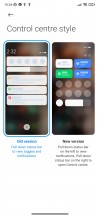


New and old notification shade and Control centre
The notification panel offers you a choice between standard Android notification cards and the revamped MIUI ones that go better with the overall MIUI aesthetics.
And even though MIUI 12.5 sounds like a minor update over the MIUI 12, it's actually a bearer of a slew of new features. Some of them are security and privacy-related. You can prevent apps from accessing your personal information such as location, private data, clipboard and even won't save passwords.


General settings menu
Secondly, Xiaomi has worked on transition animations and the overall design and compares the smoothness and simplicity of those to Apple's iOS. And we must say, we definitely do see the resemblance, for better or worse, that's for you to decide.
The system comes with fewer pre-installed apps, streamlining the system app experience. Additionally, there are several under-the-hood changes thanks to the revisited back-end code. Allegedly, the OS now draws 25% less power, and background memory usage has been decreased by 35%.
There are plenty of customization options available, starting with an abundance of wallpapers. Xiaomi has introduced a new dynamic wallpaper of the Four Sisters Mountain in China, so your phone is in line with your environment. The picture adapts to your current location's weather report while new sounds for notifications are added to better suit your surroundings. Multiple notifications will come in different tones.



Wallpapers and Themes
Themes have been an integral part of the MIUI experience, so Xiaomi has once again provided an insane number of themes in its store.
In terms of more general UX tweaks, you can choose whether you want an app drawer or not, as well as tweak pretty much every aspect of the system UI, like icons and their size and colors. Buttons and gestures are also naturally available for navigation, with plenty of customizable gestures.

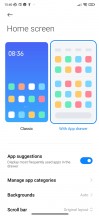


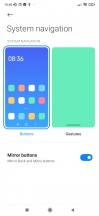
Home screen and navigation options
The app drawer, should you choose to use it, is highly customizable in its own right as well. There are categories to adjust, as well as more visual aspects, like the slider and backgrounds.






Add drawer settings
There is also a nifty, dedicated Lite mode that saves you the trouble of dealing with all of these UX tweaks and simply leaves you with a cleaner, bigger and pretty well-organized experience, perfect for minimalists or remedial users.
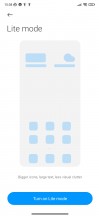


Lite mode
The extra features don't stop there either; there is an "Additional settings" menu, with more than a few interesting entries, like a feature-rich screen recorder, an in-depth button-shortcut customizer and even a special maintenance mode meant to clear out your speaker from dirt.


Additional settings
Then there is also the "Special features" menu, which has even more extra features, like the Lite mode we already mentioned. Here we also find a Video toolbox, which is a set of real-time filters and effects that can be applied to video players on the fly and on a per-app basis. Also, "Game Turbo" - Xiaomi's game launcher - complete with a game optimizer and an in-game toolbar.


Special features and Game Turbo
Floating Windows allows you to open an app in a floating window, which will appear on top of everything else you open, even a full-screen app. The feature is now more easily accessible via the recent apps menu. Which, by the way, offers deep memory clean that wipes off the apps that are loaded into the RAM.
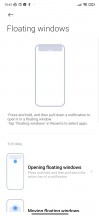

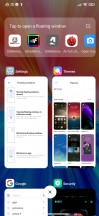


Floating windows
Honestly, the sheer number of additional features that MIUI 12.5 offers is awe-inspiring, particularly on a budget device like the Redmi Note 8 2021. Few custom ROMs, if any, can even come close in terms of feature set. There is even Android Auto baked straight in.
You've probably already picked it up by now that we liked the way MIUI 12.5 turned out. It's well-designed, it offers an abundance of cool features, and it runs great, for the most part. We did notice some minor slowdowns and hiccups, but that's to be expected given the modest hardware the Redmi Note 8 2021 has to work with. Also, the Memory extension feature, as seen on the recent Redmi 10, was nowhere to be found. Otherwise, day-to-day performance is really good.
Performance
Time for some real talk. Why would Xiaomi take the perfectly good Snapdragon 665 from the original Redmi Note 8, rip it out and replace it with a MediaTek Helio G85, as found in the new Redmi Note 8 2021. Clearly, the downgrade in the chipset's DSP capabilities from 4K video capture, down to 1080p weren't a desired thing for the engineering team. Nor marketing, for that matter. Why would a special edition commemorating the huge sales success of the regular one be deliberately worse? Well, it almost certainly has to do with the ongoing chip shortage we are currently experiencing.

Due to a number of factors, including the ongoing global pandemic and steadily-increasing demand for all sorts of chips by the PC industry, as well as other major clients, like the new generation of gaming consoles, the tech industry, collectively, is experiencing a huge and prolonged shortage of chips. Why don't they just make more, some of you might ask? Well, it's that would take a lengthy explanation to cover in its entirely, since it has to touch upon things like chip manufacturing processes, limitations and requirements, fab capacity, time allotment, binning, supply chains and all sorts of other things. Simply put - it is proving very hard to remedy this shortage on multiple levels, and we are likely to continue experiencing it for a while to come. Hence, to grossly simplify the particular situation Xiaomi likely faced with the Redmi Note 8 2021 - there were simply not enough Snapdragon 665 chips out there for one reason or another.
Hope that crude explanation at last partially explains the situation. The chipset swap clearly leaves the new Redmi Note 8 2021 a bit deficient, particularly in the CPU department. Even though the two chips are sort of comparable, the Snapdragon 665 has four performance Kryo 260 Gold cores, clocked at up to 2.0 GHz and another four Kryo 260 Silver, going up to 1.8 GHz, whereas the MediaTek Helio G85 gets just two "big" 2.0 GHz Cortex-A75 and another six 6x1.8 GHz Cortex-A55 ones.
GeekBench 5 (multi-core)
Higher is better
-
Huawei P40 Lite
1862 -
Realme 8 5G
1784 -
Realme Narzo 30 5G
1783 -
Xiaomi Redmi Note 10 Pro
1780 -
Xiaomi Redmi Note 9T
1775 -
Samsung Galaxy A22 5G
1719 -
Realme 8
1690 -
Xiaomi Redmi Note 10
1599 -
Xiaomi Redmi Note 10S
1576 -
Xiaomi Redmi 9T
1400 -
Realme Narzo 20A
1400 -
Poco M3
1398 -
Motorola Moto G Pro
1385 -
Xiaomi Redmi Note 8
1339 -
Realme Narzo 20
1328 -
Xiaomi Redmi 9 (Prime)
1325 -
Huawei Y7a / P smart 2021
1321 -
Xiaomi Redmi Note 8 2021
1314 -
Xiaomi Redmi 10
1294 -
Redmi Note 9
1292 -
Motorola Moto G30
1265 -
Motorola Moto G10
1139 -
Samsung Galaxy A12
1034 -
Samsung Galaxy A02s
495
Even so, on a much more positive note, looking at GeekBench and its pure-CPU loads, we can see the older Redmi Note 8 outpaces the Redmi Note 8 2021 by just a few points in multi-core testing, where the higher total CPU clock of the former has the upper hand. But, the difference is not that big. This is most likely due to the fact the Cortex-A75 and A55 cores inside the MediaTek chip are simply newer and more efficient than the Kryo 260 Gold and Silver of the Snapdragon. Those are Cortex-A73 and Cortex-A53 derivatives, respectively.
GeekBench 5 (single-core)
Higher is better
-
Xiaomi Redmi Note 9T
595 -
Huawei P40 Lite
591 -
Realme Narzo 30 5G
572 -
Xiaomi Redmi Note 10 Pro
569 -
Realme 8 5G
569 -
Samsung Galaxy A22 5G
560 -
Xiaomi Redmi Note 10
534 -
Realme 8
533 -
Xiaomi Redmi Note 10S
502 -
Realme Narzo 20
385 -
Xiaomi Redmi 9 (Prime)
362 -
Xiaomi Redmi 10
361 -
Redmi Note 9
361 -
Xiaomi Redmi Note 8 2021
352 -
Xiaomi Redmi Note 8
315 -
Realme Narzo 20A
314 -
Motorola Moto G Pro
311 -
Poco M3
308 -
Xiaomi Redmi 9T
307 -
Motorola Moto G30
306 -
Huawei Y7a / P smart 2021
299 -
Motorola Moto G10
247 -
Samsung Galaxy A12
169 -
Samsung Galaxy A02s
131
This benefit of newer design is clearly visible in the single-core runs, where the entire load is put on one of the bigger cores and the Cortex-A75 of the Redmi Note 8 2021 outpaces the Kryo 260 Gold (Cortex-A73) of the older Redmi Note 8.
Simply put, in terms of CPU performance, the Redmi Note 8 2021 is about as good as its predecessor, with little to no difference in practical terms.
Moving on to more compound benchmarks like AnTuTu, we, in fact, start to see the newer Redmi Note 8 2021 model gain even more momentum and a wider lead on its predecessor. AnTuTu does take into account some additional hardware factors, like RAM and storage size and speed, and for the sake of thoroughness, we should note that our testing was done on a 4GB/64GB Redmi Note 8 unit and a 4GB/128GB variant of the new Redmi Note 8 2021, which could account for some of the difference in score. The newer OS version might affect the results, too.
AnTuTu 8
Higher is better
-
Huawei P40 Lite
325777 -
Realme 8 5G
302059 -
Realme 8
298328 -
Xiaomi Redmi Note 10 Pro
295442 -
Realme Narzo 30 5G
290161 -
Xiaomi Redmi Note 9T
288732 -
Samsung Galaxy A22 5G
242155 -
Xiaomi Redmi Note 10
218788 -
Xiaomi Redmi 9 (Prime)
201829 -
Redmi Note 9
200414 -
Realme Narzo 20
193912 -
Xiaomi Redmi Note 8 2021
180195 -
Xiaomi Redmi 9T
177917 -
Poco M3
177904 -
Motorola Moto G Pro
173611 -
Motorola Moto G30
170968 -
Realme Narzo 20A
169543 -
Xiaomi Redmi Note 8
161572 -
Huawei Y7a / P smart 2021
161106 -
Motorola Moto G10
140230 -
Samsung Galaxy A12
107189 -
Samsung Galaxy A02s
90811
AnTuTu 9
Higher is better
-
Realme 8 5G
361505 -
Realme 8
357488 -
Xiaomi Redmi Note 10S
330909 -
Samsung Galaxy A22 5G
223188 -
Xiaomi Redmi Note 8 2021
165779
A much bigger contributor for the higher score, however, seems to be the GPU setup. The new Redmi Note 8 2021 is rocking a Mali-G52 MC2 setup, which, while definitely not impressive in absolute terms, appears to be performing better than the Adreno 610 inside the original Redmi Note 8.
GFX Manhattan ES 3.0 (offscreen 1080p)
Higher is better
-
Realme 8
53 -
Huawei P40 Lite
53 -
Realme 8 5G
38 -
Realme Narzo 30 5G
38 -
Samsung Galaxy A22 5G
32 -
Xiaomi Redmi Note 8 2021
25 -
Realme Narzo 20
25 -
Xiaomi Redmi Note 10
24 -
Huawei Y7a / P smart 2021
21 -
Motorola Moto G30
20 -
Xiaomi Redmi 9T
19 -
Poco M3
19 -
Xiaomi Redmi Note 8
19 -
Motorola Moto G Pro
19 -
Realme Narzo 20A
19 -
Motorola Moto G10
14 -
Samsung Galaxy A12
12 -
Samsung Galaxy A02s
9.3
GFX Manhattan ES 3.0 (onscreen)
Higher is better
-
Huawei P40 Lite
49 -
Realme 8
48 -
Realme Narzo 20
44 -
Realme 8 5G
35 -
Realme Narzo 30 5G
35 -
Motorola Moto G30
34 -
Realme Narzo 20A
33 -
Samsung Galaxy A22 5G
31 -
Motorola Moto G10
25 -
Xiaomi Redmi Note 8 2021
22 -
Xiaomi Redmi Note 10
21 -
Samsung Galaxy A12
19 -
Huawei Y7a / P smart 2021
18 -
Motorola Moto G Pro
18 -
Xiaomi Redmi 9T
17 -
Poco M3
17 -
Samsung Galaxy A02s
16 -
Xiaomi Redmi Note 8
16
This is also clear from the various GFXBench runs, where the Redmi Note 8 2021 manages a consistent lead, which remains present even as the tests themselves ramp-up in difficulty.
GFX Manhattan ES 3.1 (offscreen 1080p)
Higher is better
-
Huawei P40 Lite
34 -
Realme 8
33 -
Realme 8 5G
25 -
Realme Narzo 30 5G
25 -
Samsung Galaxy A22 5G
24 -
Xiaomi Redmi Note 10
17 -
Xiaomi Redmi Note 8 2021
16 -
Realme Narzo 20
16 -
Huawei Y7a / P smart 2021
15 -
Motorola Moto G30
14 -
Xiaomi Redmi 9T
13 -
Poco M3
13 -
Xiaomi Redmi Note 8
13 -
Motorola Moto G Pro
13 -
Realme Narzo 20A
13 -
Motorola Moto G10
9.4 -
Samsung Galaxy A12
7.7 -
Samsung Galaxy A02s
6.1
GFX Manhattan ES 3.1 (onscreen)
Higher is better
-
Realme Narzo 20
32 -
Huawei P40 Lite
30 -
Realme 8
29 -
Motorola Moto G30
26 -
Realme Narzo 20A
26 -
Realme 8 5G
22 -
Realme Narzo 30 5G
22 -
Samsung Galaxy A22 5G
21 -
Motorola Moto G10
19 -
Xiaomi Redmi Note 10
15 -
Xiaomi Redmi Note 8 2021
14 -
Samsung Galaxy A12
13 -
Huawei Y7a / P smart 2021
13 -
Samsung Galaxy A02s
12 -
Motorola Moto G Pro
12 -
Poco M3
11 -
Xiaomi Redmi Note 8
11 -
Xiaomi Redmi 9T
10
GFX Car Chase ES 3.1 (offscreen 1080p)
Higher is better
-
Huawei P40 Lite
21 -
Realme 8
20 -
Xiaomi Redmi Note 10 Pro
19 -
Realme Narzo 20
16 -
Realme 8 5G
15 -
Realme Narzo 30 5G
15 -
Samsung Galaxy A22 5G
14 -
Xiaomi Redmi Note 8 2021
9.6 -
Xiaomi Redmi Note 10
9.3 -
Huawei Y7a / P smart 2021
8.5 -
Xiaomi Redmi 9T
7.5 -
Motorola Moto G30
7.3 -
Poco M3
7.2 -
Realme Narzo 20A
7.2 -
Motorola Moto G Pro
7.1 -
Xiaomi Redmi Note 8
7 -
Motorola Moto G10
5.2 -
Samsung Galaxy A02s
3.4 -
Samsung Galaxy A12
3.3
GFX Car Chase ES 3.1 (onscreen)
Higher is better
-
Realme 8
18 -
Huawei P40 Lite
18 -
Realme Narzo 20
18 -
Xiaomi Redmi Note 10 Pro
16 -
Realme 8 5G
13 -
Realme Narzo 30 5G
13 -
Motorola Moto G30
13 -
Realme Narzo 20A
13 -
Samsung Galaxy A22 5G
12 -
Motorola Moto G10
9.2 -
Xiaomi Redmi Note 8 2021
8.7 -
Xiaomi Redmi Note 10
7.9 -
Huawei Y7a / P smart 2021
7 -
Motorola Moto G Pro
6.6 -
Samsung Galaxy A02s
6.1 -
Poco M3
5.9 -
Xiaomi Redmi Note 8
5.9 -
Xiaomi Redmi 9T
5.8 -
Samsung Galaxy A12
5
Mind you, generally it is not advisable to compare on-screen test scores across different devices due to the differences in resolution. Even a few pixels can invalidate such comparisons. However, when looking at the Redmi Note 8 and the new Redmi Note 8 2021, in particular, this is clearly not a consideration, since both phones have the exact same 1080 x 2340-pixel resolution.
GFX Aztek Vulkan High (onscreen)
Higher is better
-
Realme 8
11 -
Motorola Moto G30
8.7 -
Huawei P40 Lite
8.6 -
Samsung Galaxy A22 5G
7.8 -
Motorola Moto G10
6.3 -
Xiaomi Redmi Note 10
5.3 -
Xiaomi Redmi Note 8 2021
4.7 -
Xiaomi Redmi 9T
4.1 -
Poco M3
4.1 -
Samsung Galaxy A12
3.8 -
Huawei Y7a / P smart 2021
3.7 -
Samsung Galaxy A02s
3.5
GFX Aztek ES 3.1 High (onscreen)
Higher is better
-
Realme 8
12 -
Huawei P40 Lite
12 -
Motorola Moto G30
9.1 -
Samsung Galaxy A22 5G
8.4 -
Motorola Moto G10
6.5 -
Xiaomi Redmi Note 10
5.6 -
Xiaomi Redmi Note 8 2021
5.4 -
Samsung Galaxy A12
4.6 -
Huawei Y7a / P smart 2021
4.3 -
Samsung Galaxy A02s
3.5 -
Poco M3
2.8 -
Xiaomi Redmi 9T
2.7
GFX Aztek Vulkan High (offscreen 1440p)
Higher is better
-
Realme 8
7.5 -
Samsung Galaxy A22 5G
5.1 -
Xiaomi Redmi 9T
4.2 -
Poco M3
4.2 -
Xiaomi Redmi Note 10
3.5 -
Xiaomi Redmi Note 8 2021
3.1 -
Motorola Moto G30
2.8 -
Huawei Y7a / P smart 2021
2.6 -
Motorola Moto G10
2 -
Samsung Galaxy A12
1.2 -
Samsung Galaxy A02s
1.1
GFX Aztek ES 3.1 High (offscreen 1440p)
Higher is better
-
Realme 8
7.7 -
Samsung Galaxy A22 5G
5.5 -
Xiaomi Redmi Note 10
3.7 -
Xiaomi Redmi Note 8 2021
3.4 -
Huawei Y7a / P smart 2021
2.9 -
Xiaomi Redmi 9T
2.8 -
Poco M3
2.8 -
Motorola Moto G30
2.8 -
Motorola Moto G10
2 -
Samsung Galaxy A12
1.5 -
Samsung Galaxy A02s
1.2
Unfortunately, we don't have Aztek runs, nor 3DMark ones for the original Redmi Note 8, but we fully expect the results to paint the same picture. The Motorola Moto G Pro and the Realme Narzo 20A, rocking the same Snapdragon 665 chipset with an Adreno 610 GPU are a testament to that.
3DMark SSE ES 3.1 (offscreen 1440p)
Higher is better
-
Xiaomi Redmi Note 9T
3147 -
Huawei P40 Lite
2818 -
Realme 8
2610 -
Samsung Galaxy A22 5G
2391 -
Realme Narzo 30 5G
2357 -
Xiaomi Redmi Note 10
1471 -
Realme Narzo 20
1400 -
Xiaomi Redmi Note 8 2021
1399 -
Motorola Moto G30
1185 -
Xiaomi Redmi 9T
1181 -
Poco M3
1175 -
Motorola Moto G Pro
1127 -
Huawei Y7a / P smart 2021
1088 -
Realme Narzo 20A
1065 -
Motorola Moto G10
855 -
Samsung Galaxy A02s
438 -
Samsung Galaxy A12
365
3DMark SSE Vulkan 1.0 (offscreen 1440p)
Higher is better
-
Xiaomi Redmi Note 9T
3003 -
Realme 8
2639 -
Huawei P40 Lite
2603 -
Realme Narzo 30 5G
2260 -
Samsung Galaxy A22 5G
2257 -
Xiaomi Redmi Note 8 2021
1424 -
Realme Narzo 20
1382 -
Xiaomi Redmi Note 10
1372 -
Motorola Moto G30
1142 -
Motorola Moto G Pro
1125 -
Realme Narzo 20A
1111 -
Xiaomi Redmi 9T
1107 -
Poco M3
1106 -
Huawei Y7a / P smart 2021
1060 -
Motorola Moto G10
818 -
Samsung Galaxy A12
612 -
Samsung Galaxy A02s
489
3DMark Wild Life Vulkan 1.1 (offscreen 1440p)
Higher is better
-
Xiaomi Redmi Note 9T
1571 -
Realme 8
1486 -
Realme Narzo 30 5G
1105 -
Realme 8 5G
1104 -
Samsung Galaxy A22 5G
1104 -
Xiaomi Redmi Note 8 2021
722 -
Huawei Y7a / P smart 2021
563 -
Xiaomi Redmi Note 10
482 -
Motorola Moto G30
389 -
Poco M3
368 -
Xiaomi Redmi 9T
365 -
Motorola Moto G10
253
So, to sum up, the Redmi Note 8 2021 performs measurably better than the original Redmi Note 8 in GPU tasks and about as well with CPU ones. So, in terms of performance, even synthetically-measure one, that is not directly translatable to real-world experience, the chipset swap has not harmed the Redmi Note 8 2021.
This is nothing short of great news, especially since we can attest that the two also behave comparably in real-life terms. That is to say, you can expect the occasional hiccup and stutter here and there, particularly with games and for a split second when executing a heavy task or launching some apps. Overall, however, there is more than enough power here to chew through regular, every-day tasks with ease. And MIUI rarely experiences any slowdowns whatsoever.

This is all great news for Xiaomi, and we do appreciate the upgrade to Bluetooth 5.2 the MediaTek Helio G85 brings about as well. However, the newfound DSP video capture limitation of FullHD remains a truly hard pill to swallow. Even if all of the performance is there, it remains a massive potential drawback, working against the Redmi Note 8 2021.


Tip us
2.1m 180k
RSS
EV
Merch
Log in I forgot my password Sign up