Xiaomi Redmi Note 15 Pro+ review
Android 15 and HyperOS 2
Just like the Redmi Note 14 series, the Redmi Note 15 phones launch with a generation behind of Android and HyperOS. Android 16 has been around for a while now, and the Poco F8 series that debuted a couple of months earlier runs on Android 16-based HyperOS 3 out of the box. The fact is a bit underwhelming - we would have expected Android 16 to come pre-installed here as well.

Update, 30 Dec 2025: The company promises 4 major OS updates and 6 years of security patches for the entire Redmi Note 15 series.
That still doesn't change the fact that even if Xiaomi delivers the update quickly, it will still count against the promised number of updates.
In any case, let's go through some of the main features that define HyperOS 2. But before that, make sure to watch our dedicated HyperOS 2 deep dive video.
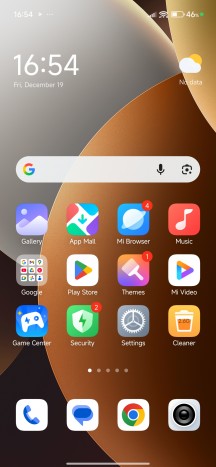
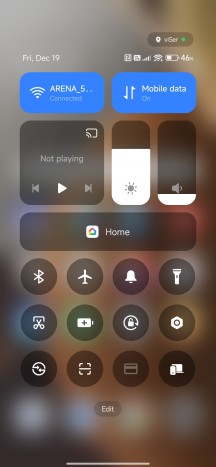
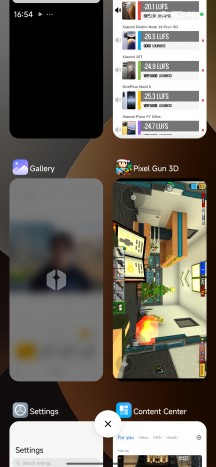
Home screen • Control Center • Recent apps
Notably, not all features in the video or in other higher-end Xiaomi phones are available. The most noticeable omission is some of the AI features. There's no HyperAI sub-menu in the settings, but you can still use the AI-based photo editing tools in the Gallery, such as erase, background separation, sky enhancer, etc. You can also use AI-generated subtitles or generate wallpapers.
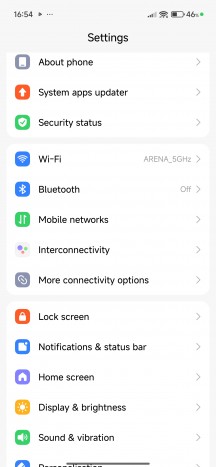
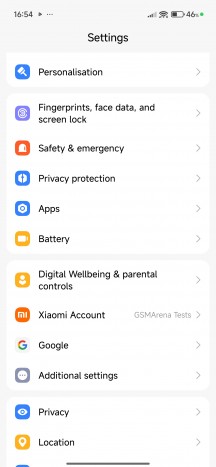
Settings menu
Of course, Google's Gemini and Circle to Search are also on board.
Benchmark performance
The Snapdragon 7s Gen 4 SoC is a fairly new chip, and it's a successor to the SD 7 Gen 3. While both are built on the 4nm manufacturing node, the newer silicon features a higher-clocked octa-core CPU and a new Adreno 810 GPU.

The processor has 1x Prime Cortex-A720 core now clocked at 2.7 + 3x Cortex-A720 (2.4GHz) units and 4x Cortex-A520 (1.8GHz).
The new Adreno 810 brings improved performance, and it has Snapdragon Elite Gaming features like Adaptive Performance Engine 3.0 and Snapdragon Game Super Resolution.
The updated Hexagon NPU offers better AI performance with support for Llama 1B and Qwen 1B and real-time translation. On the connectivity side, the new 7s Gen 4 chip supports Wi-Fi 6E and Bluetooth 5.4. It also brings support for the aptX Lossless and aptX Adaptive audio codecs.
Memory-wise, the handset is offered in 8GB/256GB, 12GB/256GB and 12GB/512GB memory/storage configurations. Regardless of the storage option, you get a UFS 2.2 storage chip, but it's quite a fast one with read and write speeds up to 1000MB/s.
GeekBench 6
- Single-core
- Multi-core
 Poco F7 Ultra
 Realme GT 7
 OnePlus Nord 5
 Xiaomi 15T
 Redmi Note 15 Pro+
 Redmi Note 14 Pro+
3DMark - Wild Life Extreme (Highest)
Poco F7 Ultra
Realme GT 7
Xiaomi 15T
OnePlus Nord 5
Redmi Note 15 Pro+
Redmi Note 14 Pro+
We couldn't run Antutu on this unit because the benchmark is usually blocked on Xiaomi phones before they are announced to avoid leaks. We expect to get scores soon.
It seems like the Redmi Note 15 Pro+ utilizes the Snapdragon 7s Gen 4's capabilities to the fullest, which in turn is only marginally faster than the SD 7s Gen 3 used in the previous Redmi Note 14 Pro+ generation.
However, raw performance is rather underwhelming given that many similarly priced handsets offer significantly more powerful shipsets. Take the OnePlus Nord 5 or the Xiaomi 15T, for example. They show notably higher CPU and GPU performance with their Snapdragon 8s Gen 3 and Dimensity 8400 Ultra chips. It's also hard to ignore the Poco F7 Ultra and the Realme GT 7, even though they are a bit of outliers, but they are asking around the same amount of money and run on higher-end chipsets.
Sustained performance
The Snapdragon 7s Gen 4 isn't particularly demanding, so it's no surprise that the phone handles heavy workloads with ease. In both CPU and GPU stress tests, the chipset maintained near-maximal performance.
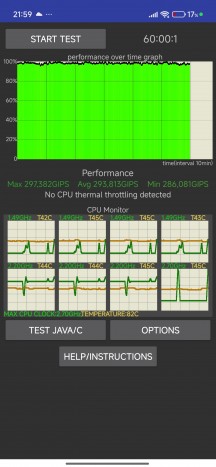
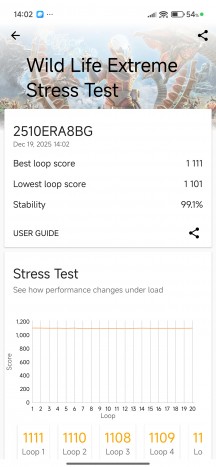
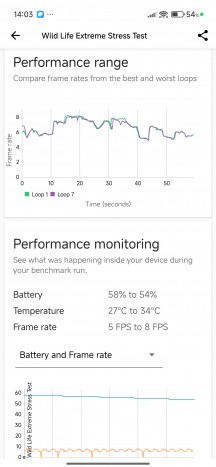
CPU and GPU stress tests
Even the chassis of the handset didn't get hot. It was just a bit warm at worst.


Tip us
2.1m 180k
RSS
EV
Merch
Log in I forgot my password Sign up