Motorola Moto G7 review
Moto-modded Android 9.0 Pie
The Moto G7, in typical Moto fashion, runs near-stock Android and it's 9.0 Pie in this case. Again, typically, a set of customization options is neatly arranged in a Moto app of sorts.

Those are neatly grouped into Moto Actions, Moto Display, and Moto Voice, and the first category is the largest. It includes universal classics like 'Flip for DND' and 'Pick up for silence', as well as Moto-specific Moto Actions like the wrist-twist 'Quick capture' gesture to open the camera.


Moto customizations
Chief among the Moto Actions is the One Button Nav, which replaces the three-button navigation bar with a wider single button that you swipe here and there to get stuff done. By default, you swipe left on the bar to go Back, swipe right to quickly switch between the last two apps, swipe up for the task switcher, tap the bar to go Home, and tap-hold for Google Assistant. The left and right swipes can be switched around.
It's a slightly different implementation than what Google's done with the Pixel launcher and if you're coming from a Google handset it can be infuriating switching back and forth. To be fair, though, Motorola was already doing a similar gesture based navigation as far back as the Moto Z2. If anything, the latest version they have in place now on the G7s is more logical than Google's own, where they have a back button that's a bit out of place.
Then again, the One Button Nav bar is still a nav bar and takes up the same space as the classic solution, and in that sense it's not as forward as fully gesture-based UIs like Xiaomi's MIUI, for example.


One Button Nav
Moto Display consists of just two options on the Moto G7 and the more important one is Peek Display - the not-always-on display. It'll display notifications and let you interact with them right there on the lockscreen plus it'll wake up when you approach your phone. Moto Voice's Talk to me feature will announce incoming calls and texts - helpful if your hands are full for some reason.


Peek Display • Talk to me
All of these aside, the rest is pretty much Android 9.0 Pie as Google intended it to be - well, there's also the greenish hue of the quick toggles.


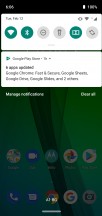
Lockscreen • Homescreen • Folder view • App drawer • Task switcher • Notification shade
When it comes to multimedia, it's all in the hands of Google and its default apps. Google Photos is in charge of gallery-related tasks and video playback, while Google Play Music is the audio player. There's an FM radio too, with RDS and recording capability.


Google Photos • Google Play Music • FM Radio apps is excellent
Performance and benchmarks
Unlike the G7 Plus with its Snapdragon 636 chipset, the plain Moto G7 comes with the Snapdragon 632 - same as the Power and Play variants. The CPU packs eight Kryo 250 cores, four Gold ones clocked at 1.8GHz and four Silver ones at... 1.8GHz - yay, Qualcomm naming!
The GPU is Adreno 506, and it's here that the marginal difference in naming compared to the Adreno 509 of the Moto G7 Plus will have a more meaningful impact on performance than the Kryo 250 vs. 260 processor cores.
Our review unit is equipped with 4GB of RAM and 64GB of storage and to the best of our knowledge that's the only existing configuration. Motorola can always come up with some other regional options, however.

To illustrate our point about the chip differences, let's first have a look at some GeekBench scores. In the single-core test the Moto G7 is only 6% behind its Plus stablemate, which is practically tied with a couple of other S636 phones. The relative gap is even smaller in the multi-core test. Naturally, smartphones with higher-tier chips like the S660 an S710 show more meaningful performance advantages, but within the G7 lineup the difference is minimal.
GeekBench 4.1 (single-core)
Higher is better
-
Xiaomi Mi 8 SE
1890 -
Oppo RX17 Pro
1835 -
Xiaomi Redmi Note 7
1650 -
Xiaomi Mi 8 Lite
1628 -
Honor 8X
1618 -
Samsung Galaxy A9 (2018)
1611 -
Huawei Mate 20 Lite
1595 -
Realme U1
1567 -
Samsung Galaxy A7 (2018)
1524 -
Oppo F9 (F9 Pro)
1497 -
Xiaomi Redmi Note 6 Pro
1342 -
Motorola Moto G7 Plus
1334 -
Nokia 6.1 Plus
1331 -
ASUS ZenFone Max M2
1257 -
Motorola Moto G7
1255 -
Xiaomi Mi A2 Lite (Redmi 6 Pro)
881 -
Motorola One (P30 Play)
867 -
Samsung Galaxy A6 (2018)
733
GeekBench 4.1 (multi-core)
Higher is better
-
Realme U1
6004 -
Oppo RX17 Pro
5944 -
Xiaomi Mi 8 SE
5908 -
Xiaomi Mi 8 Lite
5894 -
Samsung Galaxy A9 (2018)
5763 -
Oppo F9 (F9 Pro)
5673 -
Honor 8X
5651 -
Huawei Mate 20 Lite
5574 -
Xiaomi Redmi Note 7
5411 -
Xiaomi Redmi Note 6 Pro
4933 -
Nokia 6.1 Plus
4929 -
Motorola Moto G7 Plus
4927 -
Motorola Moto G7
4755 -
ASUS ZenFone Max M2
4744 -
Samsung Galaxy A7 (2018)
4446 -
Xiaomi Mi A2 Lite (Redmi 6 Pro)
4388 -
Motorola One (P30 Play)
4183 -
Samsung Galaxy A6 (2018)
3718
It's the GPU on the Moto G7 that proves underpowered compared to the one the G7 Plus is rocking - the Plus posts significantly higher fps numbers in all tests. Competition from other chipmakers is also coming strong, with the Galaxy A7 (2018)'s Exynos 7885 on par with the G7 Plus's S636, and the Kirin 710 in the various Huaweis being even better.
GFX 3.1 Manhattan (1080p offscreen)
Higher is better
-
Xiaomi Mi 8 SE
23 -
Oppo RX17 Pro
23 -
Xiaomi Mi 8 Lite
15 -
Samsung Galaxy A9 (2018)
15 -
Xiaomi Redmi Note 7
15 -
Huawei Mate 20 Lite
14 -
Honor 8X
14 -
Realme U1
13 -
Oppo F9 (F9 Pro)
12 -
Motorola Moto G7 Plus
10 -
Nokia 6.1 Plus
10 -
Xiaomi Redmi Note 6 Pro
10 -
Samsung Galaxy A7 (2018)
10 -
Nokia 5.1 Plus
9.6 -
Motorola Moto G7
6.9 -
ASUS ZenFone Max M2
6.9 -
Xiaomi Mi A2 Lite (Redmi 6 Pro)
6.5 -
Motorola One (P30 Play)
6.4 -
Samsung Galaxy A6 (2018)
3.2
GFX 3.1 Manhattan (onscreen)
Higher is better
-
Xiaomi Mi 8 SE
22 -
Nokia 5.1 Plus
20 -
Oppo RX17 Pro
19 -
ASUS ZenFone Max M2
14 -
Samsung Galaxy A9 (2018)
14 -
Huawei Mate 20 Lite
13 -
Honor 8X
13 -
Xiaomi Mi 8 Lite
13 -
Xiaomi Redmi Note 7
13 -
Motorola One (P30 Play)
13 -
Realme U1
12 -
Oppo F9 (F9 Pro)
11 -
Motorola Moto G7 Plus
9.7 -
Xiaomi Redmi Note 6 Pro
9.7 -
Nokia 6.1 Plus
9.6 -
Samsung Galaxy A7 (2018)
9.4 -
Samsung Galaxy A6 (2018)
6.7 -
Motorola Moto G7
6.4 -
Xiaomi Mi A2 Lite (Redmi 6 Pro)
6.1
GFX 3.1 Car scene (1080p offscreen)
Higher is better
-
Xiaomi Mi 8 SE
13 -
Oppo RX17 Pro
13 -
Samsung Galaxy A9 (2018)
9.1 -
Xiaomi Mi 8 Lite
9 -
Xiaomi Redmi Note 7
9 -
Realme U1
7.9 -
Huawei Mate 20 Lite
7.6 -
Honor 8X
7.6 -
Oppo F9 (F9 Pro)
7.5 -
Motorola Moto G7 Plus
6.3 -
Nokia 6.1 Plus
6.3 -
Xiaomi Redmi Note 6 Pro
6.3 -
Samsung Galaxy A7 (2018)
6.3 -
Nokia 5.1 Plus
5.9 -
ASUS ZenFone Max M2
3.9 -
Motorola Moto G7
3.8 -
Xiaomi Mi A2 Lite (Redmi 6 Pro)
3.6 -
Motorola One (P30 Play)
3.6 -
Samsung Galaxy A6 (2018)
2
GFX 3.1 Car scene (onscreen)
Higher is better
-
Xiaomi Mi 8 SE
12 -
Oppo RX17 Pro
11 -
Samsung Galaxy A9 (2018)
8.3 -
Xiaomi Mi 8 Lite
8 -
ASUS ZenFone Max M2
7.7 -
Xiaomi Redmi Note 7
7.7 -
Nokia 5.1 Plus
7.4 -
Motorola One (P30 Play)
7.2 -
Realme U1
7.1 -
Huawei Mate 20 Lite
6.7 -
Honor 8X
6.7 -
Oppo F9 (F9 Pro)
6.5 -
Motorola Moto G7 Plus
5.9 -
Nokia 6.1 Plus
5.9 -
Xiaomi Redmi Note 6 Pro
5.9 -
Samsung Galaxy A7 (2018)
5.7 -
Samsung Galaxy A6 (2018)
3.9 -
Motorola Moto G7
3.5 -
Xiaomi Mi A2 Lite (Redmi 6 Pro)
3.4
In Antutu, where all subsystems are tested simultaneously, the Moto G7 again trails the G7 Plus by a small margin. Other SD636 phones are also ahead of the vanilla G7, as expected.
AnTuTu 7
Higher is better
-
Xiaomi Mi 8 SE
170218 -
Oppo RX17 Pro
154861 -
Realme U1
144436 -
Xiaomi Mi 8 Lite
143257 -
Samsung Galaxy A9 (2018)
140500 -
Xiaomi Redmi Note 7
139075 -
Honor 8X
137276 -
Huawei Mate 20 Lite
136583 -
Samsung Galaxy A7 (2018)
123883 -
Nokia 5.1 Plus
119428 -
Motorola Moto G7 Plus
117829 -
Xiaomi Redmi Note 6 Pro
115605 -
Nokia 6.1 Plus
115571 -
Motorola Moto G7
106292 -
ASUS ZenFone Max M2
103243 -
Motorola One (P30 Play)
81024 -
Xiaomi Mi A2 Lite (Redmi 6 Pro)
77964 -
Samsung Galaxy A6 (2018)
63632


Tip us
2.1m 180k
RSS
EV
Merch
Log in I forgot my password Sign up