Tecno Pova 8 review
Display
The Pova 8 is a budget phone, so some corners had to be cut. The 6.76-inch display is one example. It still offers FHD+ resolution of FHD+ and can refresh at up to 144Hz, but it's not the most impressive around.

In our standardized measurements, the Pova 8 almost managed to crack 1,000 nits of brightness. That is with auto brightness turned on, as well as the additional "extra brightness" toggle enabled. In regular mode, by just maxing out the slider, we got around 650 nits. This is far from spectacular, but you shouldn't have too much trouble seeing the display even in sunny conditions. Direct sunlight may wash out colors, but still.
Max display brightness test
White test pattern (nits)
- Manual (75% fill)
- Auto (75% fill)
- Peak Auto (10% fill)
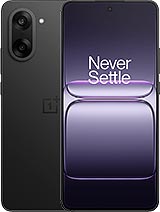
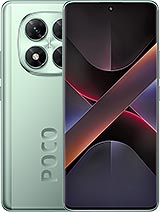
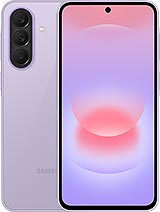
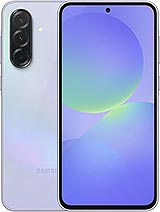
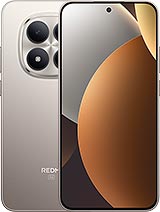 Redmi Note 15 Pro 5G
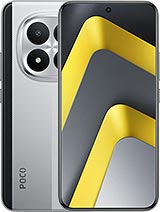
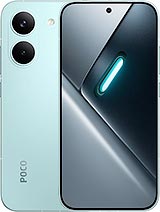 Poco X8 Pro
 Infinix Note 50 Pro 4G
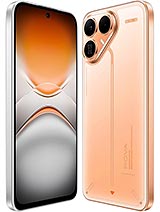 Tecno Pova 8
 Galaxy A26
 Galaxy A17
 Galaxy A07 4G
The 144Hz refresh rate sounds good on paper, but the Pova 8 doesn't exactly offer a whole lot of flexibility when it comes to actually using said refresh rate. There is a "high" refresh rate mode with per-app settings that does allow many apps to push past the 60Hz mark, but don't expect great consistency. High refresh rate gaming was always going to be a bit of a pipe dream with the Dimensity 7100 chipset.

The thing that really ruined our visual experience, however, was sluggish pixel response times. The Pova 8 suffers from a lot of smearing while scrolling. On top of that, the display surface is quite reflective, which is not ideal.
As you can imagine, there is no hardware HDR support here. The phone does report that it can decode HDR10, HDR10+ and HLG, just no Dolby Vision, but it won't be able to take full advantage of it. On a more positive note, at least it has the highest possible Google Widevine L1 DRM certification, allowing apps like Netflix to offer up FullHD streams.
Battery life
The large 8,000 mAh battery is arguably the key selling point of the Pova 8. With its fairly efficient chipset, it is well positioned to achieve excellent battery life.

And while the Pova 8 certainly does not disappoint in the battery department, frankly, we expected a bit more still. The Active Use Score of over 17 hours should be enough to live up to Tecno's marketing claims of two-day battery life. At least with most casual users.
Charging speed
The Pova 8 supports 45W Tecno fast charging. It is proprietary, but luckily you do get the charger and accompanying cable in the box in most places.

To be perfectly frank, we expected a bit faster charging times. We made sure to do a few charging runs just to make sure everything was working properly and diligently selected the kind of obscure rapid charging option from the charging notification each time. Tecno claims 45W but in our measurements, the actual charging never really exceeded 25W.
Tecno claims that the Pova 8 can fill its large battery up to 50% in 35 minutes. In our experience it is more like 39 minutes. Fifteen minutes on the charger resulted in 22% charge, thirty minutes gave us 39% and a full charge took just shy of an hour and a half. Not particularly impressive numbers, but not terrible either.
Charging speed
- in 15 min
- in 30 min
- Time to full charge (from 0%)
 Infinix Note 50 Pro 4G
Galaxy A17 5G
Redmi Note 15 Pro 5G
 Infinix Note Edge
Galaxy A07 4G
Tecno Pova 8
 Redmi 15 5G
In terms of battery protection features, Tecno offers Bypass Charging option, AI Charging protection (based on your routine), and Custom Charging Protection (setting a charge limit between 80% and 95%).
Speakers - loudness and quality
The Tecno Pova 8 has a dedicated bottom-firing speaker. The earpiece is outputting some audio as well and acting as a second channel, of sorts. However, the earpiece is really quiet, almost as if it is not amplified at all. Plus, you don't really get proper stereo channel isolation with the bottom speaker outputting both the left and right channels - probably so you can even hear the left. That aside, quality is actually surprisingly decent. Nothing spectacular, but mids come through clearly.

Unfortunately, the Pova 8 isn't particularly loud at all.
There are some rather interesting onboard audio enhancements to explore. The Pova 8 seems to have Dolby Atmos support, and the settings menu even suggests it's not just for headphone use. We really don't see how any of the "smart" presets will even make much of a difference since the phone effectively lacks stereo, but it is what it is.
One of the "practical AI" features is "Call Noise Suppression", or at least that's what it's called in the settings menu. That title undersells the feature a little bit since it can actually work for recordings and in-game comms as well as calls.
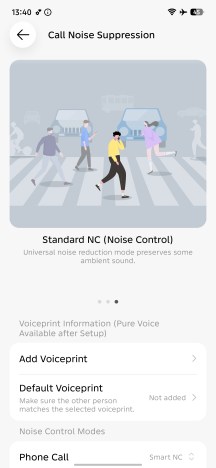
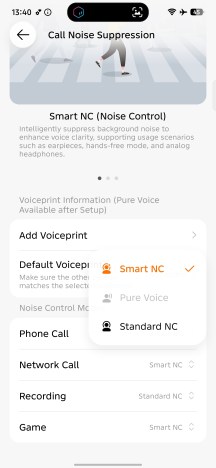
Call Noise Suppression
There is also standard Noise Control, which is your basic active noise cancellation. Ot top of that, there is a Smart option that promises to only activate when there is surrounding noise. The third and most interesting option is called "Pure Voice". The way it works is that the user records their own voice and creates a "voice print", which the system can then identify and isolate, filtering out any other voices. However, Tecno does note that this will only work correctly in a relatively quiet environment like an office setting.
Use the Playback controls to listen to the phone sample recordings (best use headphones). We measure the average loudness of the speakers in LUFS. A lower absolute value means a louder sound. A look at the frequency response chart will tell you how far off the ideal "0db" flat line is the reproduction of the bass, treble, and mid frequencies. You can add more phones to compare how they differ. The scores and ratings are not comparable with our older loudspeaker test. Learn more about how we test here.
Connectivity
The Pova 8 is a dual-SIM device. It has two Nano-SIM slots that can offer concurrent SA/NSA Sub-6 connectivity. Unfortunately, there is no eSIM support. Location services include GPS, GLONASS, GALILEO and BDS support. Local connectivity is covered by dual-band Wi-Fi 6/ac and Bluetooth 5.4 with LE support. There is NFC on board as well as an IR blaster. There is even an onboard FM radio receiver. You just need to plug in a pair of Type-C headphones to act as an antenna to use it.
Our review unit lacks a microSD card slot, but a few device listings online do mention a hybrid SIM slot 2 that can accommodate expandable storage. As far as we can tell, the Indian model has it.

The Type-C port is backed up by a simple USB 2.0 data connection, which means a theoretical throughput of up to 480 Mbps. There is USB Host/OTG support, but nothing fancy beyond that, like video output over USB Alt mode.
The Pova 8 has a pretty decent sensor loadout. That includes an st lsm6dso accelerometer and gyroscope combo, a memsic mmc5617 magnetometer and compass combo and a sensorek stk63761A light and proximity sensor combo. Yes, despite its modest price, the Pova 8 gets an actual hardware proximity sensor and not a virtual one. There is no barometer on board.


Tip us
2.1m 180k
RSS
EV
Merch
Log in I forgot my password Sign up