Tecno Pova 8 review
Single real 50MP camera on the back, 13MP selfies
The Pova 8 is no cameraphone, and its hardware reflects its relatively modest aspirations in the field. Still, it's got a well-specced main camera on the back as well as a good front-facing unit.

The rear camera is based either on the GalaxyCore GC50D1 sensor or the more well-known Sony Lytia 600 - the hardware manifest lists both models. Both are the same in their key specs, with a 1/2.0" or thereabout optical format, 0.8µm individual pixels and a Quad Bayer color filter array. The EXIF data insists on a 23mm equivalent focal length, but in hardware apps we're looking at a 24.9mm figure and that's more like the field of view we're seeing in the photos.

There's supposedly a second camera on the back, which bodes well with there being another 2MP sensor in the list of internals, but there's no apparent way to access it directly.
On the front, there's a 13MP conventional sensor (as in, not a Quad Bayer type), paired with a fixed-focus 24mm lens (no discrepancies with the focal length there).
- Wide (main): 50MP GalaxyCore GC50D1 (or Sony Lytia 600, 1/1.95", 0.8µm-1.6µm); 23mm (but probably 25mm), f/1.8, PDAF (9cm - ∞); 1440p30/1080p60 video recording.
- Front camera: 13MP GalaxyCore GC13A0 (1/3.06", 1.12µm); 24mm, f/2.2, fixed focus; 1440p30/1080p60.
Daylight photo quality
Main camera
The Pova 8's 1x photos in good light are actually pretty great. They are sharp and excellently detailed and detail has a nicely fine structure that eludes even some flagships. Dynamic range is good, though the phone does have a tendency to keep its shadows too dark for our liking. The auto white balance is accurate and colors are looking good, though saturation could use a nudge.
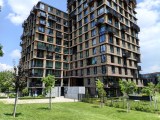









Daylight samples, main camera (1x)
That lack of vibrance is also felt in photos of people, where skin tones are a bit lifeless, though we wouldn't really call it a dealbreaker. The Portrait mode's bokeh levels are reasonable and the subject detection is quite good.






Human subjects, main camera: Photo mode, 1x • Portrait mode, 24mm • Portrait mode, 35mm
The full-res images, particularly the outdoor ones, show a tendency for overexposure, but they're also noticeably less contrasty than their binned counterparts, with brighter shadows. Detail is a little... flaky, but it's not a direct upscale job from the 12.5MP shots, so there just might be a smidge more detail if the light and subject are right and you look closely enough.
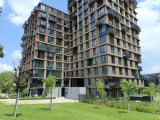



Daylight samples, main camera (1x), 50MP
With that in mind, the 12.5MP 2x zoom photos, which are seemingly center crops from the 1x 50MP ones, aren't exactly pin-sharp, but they're pretty decent nonetheless.











Daylight samples, main camera (2x)
2x photos of people are alright, and the drop in sharpness could be worth the better perspective or tighter framing. The Portrait mode shots at 50mm are noticeably softer than the Photo mode ones, though.
Human subjects, main camera: Photo mode, 2x* Portrait mode, 50mm
If you're after closeups, the main camera's 9cm minimum focusing distance will get you reasonable results. Per-pixel quality does drop at 2x, of course, but it could still be the better choice in some instances.



Close-up samples, main camera (1x)



Close-up samples, main camera (2x)
Low-light photo quality
Main camera
Low-light photos at 1x are also very good. We're looking at shots that have wide dynamic range, mostly accurate white balance and quite liberal saturation (some may say it's a touch too much). Detail is good to very good overall, depending on scene and subject matter, with the expected softening in the darker areas.








Low-light samples, main camera (1x)
At 2x zoom, the combined effects of the aggressive sharpening with the underlying softness make 1:1 examination an unpleasant task, but if you stand back a little, the photos are usable.








Low-light samples, main camera (2x)
Selfies
Selfies are pretty great on the Pova 8. Detail is very good in daylight and not too shabby in the dark either. Dynamic range is good and skin tones are looking nice though colors are a little muted once again (maybe not that indoor low-light shot, which is all over the place in many ways).








Selfie samples
Video quality
The Pova 8's video recording capabilities aren't too wide-ranging, with the top modes being 1440p30 or 1080p60 on both cameras, depending on whether you prioritize resolution or frame rate. Stabilization is limited to 1080p30 though, so both 'top' quality settings will need external means of ensuring stability. There's no HDR recording and no Pro video mode.
You can hit '> play' below and use the '>| next' button to advance through the playlist of all video samples, or you can watch the full playlist on YouTube.
Our daylight videos didn't quite reach the advertised 30fps, instead sticking to around 27.8fps, while the low-light clips were more like 29.5fps - we're not too sure what to make of that.
The stabilized 1080p30 clips are decently detailed, but the 1440p are noticeably better. 2x 1080p footage is also alright. Dynamic range and colors are pretty excellent.



Video screengrabs, daylight: 1x, 1080p • 1x, 1440p • 2x, 1080p
In the dark, you can also expect meaningfully sharper results from the 1440p mode, though it will be shaky if you're shooting handheld. 2x 1080p is probably usable, barely.



Video screengrabs, low light: 1x, 1080p • 1x, 1440p • 2x, 1080p
Camera quality verdict
There's no escaping the fact that the Tecno Pova 8 is missing an ultrawide camera, which is more or less a given in the class. The two cameras that it does have, it puts to good use though. Its rear camera captures quite nice photos both in daytime and at night, and is more or less alright at 2x zoom too. The front-facing camera takes quite great selfies too. When it comes to video, the lack of 4K is a bit of a pain point, as is the lack of stabilization in the top modes, though the stabilization you do get in 1080p30 isn't too great anyway. The 1440p footage is still quite nice if you can find means to stabilize the phone.


Tip us
2.1m 180k
RSS
EV
Merch
Log in I forgot my password Sign up