Xiaomi Redmi Pad 2 Pro review
Display
The Redmi Pad 2 Pro features a 12.1-inch IPS LCD screen with 2,560 x 1,600 pixels or 249ppi density. It supports up to 120Hz refresh rate. That's the same type of panel, resolution and refresh rate as on the Redmi Pad Pro.

There are some differences, though. This year, the screen has 10-bit color depth and supports 1B colors, down from 12-bit and 68B colors. It still supports Dolby Vision streaming.
One more thing, the tablet can be bought with a matte glass on top of its screen (our version), which boosts the visibility in demanding conditions and keeps nasty smudges and fingerprints away. However, it comes with a downside: the viewing angles are quite limited—the screen contrast is quite uneven when viewed at an angle. We are not sure if the matte glass finish or the underlying LCD panel is to blame. Viewing the screen head-on is quite all right.
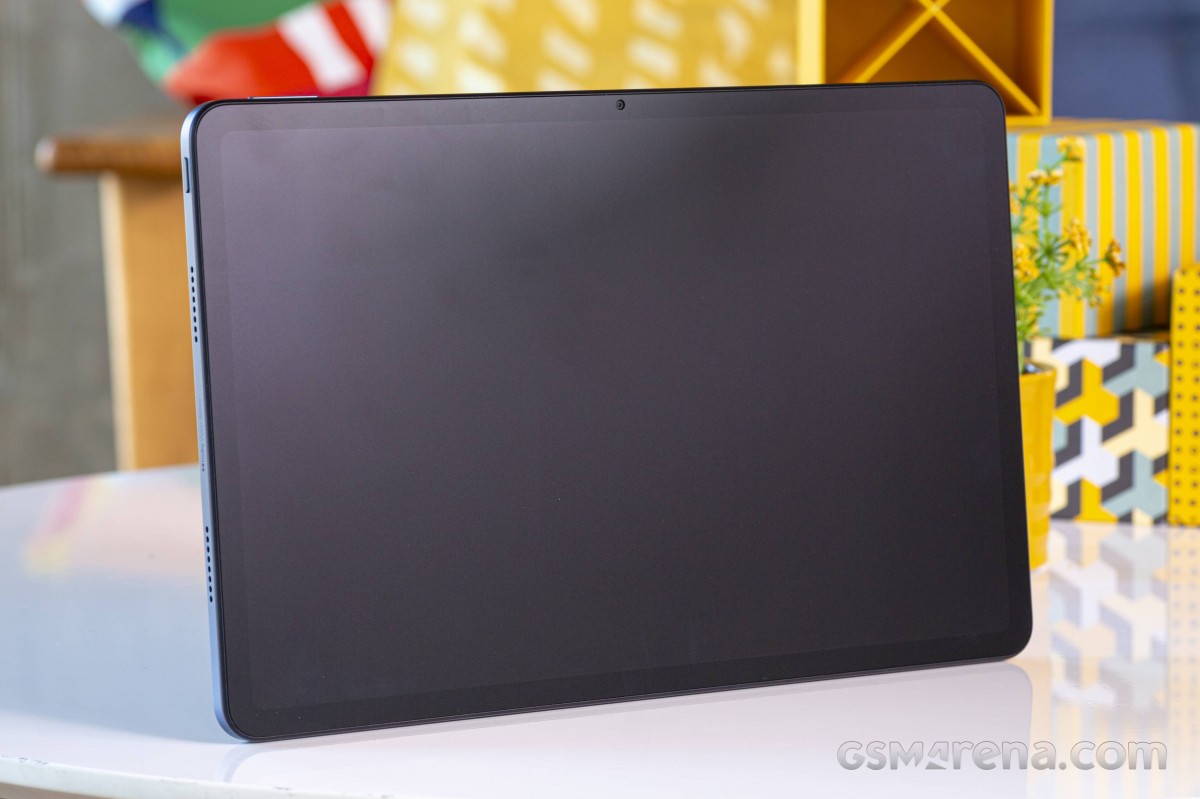
Xiaomi has listed 500nits as typical and 600nits as high maximum brightness.
We measured 472nits of maximum manual and 547nits of maximum automatic brightness. There is a Sunlight Mode, which is available when Auto Brightness is turned off - it will boost the screen brightness under bright light and it will return to your preferred fixed position when no longer needed.
The minimum brightness with a white patch was just 1.9 nit.
Max display brightness test
White test pattern, 75% fill (nits)
- Manual mode
- Auto mode
 Huawei MatePad Pro 12.2 (2025)
 Redmi Pad Pro
 Redmi Pad 2 Pro
 Redmi Pad 2
 Honor Pad X9
 Xiaomi Redmi Pad
 Xiaomi Redmi Pad SE
Refresh rate
The Redmi Pad 2 Pro screen supports up to 120Hz refresh rate. There are four modes to choose from - Default (Auto), 60Hz, 90Hz and 120Hz. The 60hz and 90Hz modes set a ceiling for refresh rate, while the Default and 120Hz modes act exactly the same, allowing the panel to go all the way to its maximum speed, but still scale down when not needed. The only difference is that Auto would prefer 90Hz for most system apps, while 120Hz will use the maximum.
The display supports 30Hz, 48Hz, 50Hz, 60Hz, 90Hz, and 120Hz steps. When the screen is idling, it usually uses 48Hz. We saw plenty of variance across different apps: 30Hz (video playback), 48Hz (streaming), 50Hz (streaming), 60Hz (videos and apps), 90Hz (some system apps and games), and 120Hz in benchmarks, games, and the system UI.
HDR
The tablet supports Dolby Vision video streaming and offers such an option in compatible apps like Netflix. There is no HDR10 support and hence there is no HDR streaming on YouTube.
Battery life
The Redmi Pad 2 Pro has a massive 12,000mAh battery, up from 10,000mAh inside the Pad Pro. Xiaomi is promising that this cell will last you 14h on video playback, 16h when reading, or 105h on music playback.
The Redmi Pad 2 Pro posted 12:55h of Active Use Score in our proprietary suite of tests, which is an outstanding result for a large tablet! The Pad 2 Pro aced all four battery tests - calls, web, video, game.
Since tablets rarely have cellular connectivity, we use Whatsapp for the call test in our tablet reviews. If you prefer, you can easily turn it off from the calculation of the Active Use Score by moving its slider to zero.
Charging speed
The Redmi Pad 2 Pro supports 33W fast battery charging. It can also reversely recharge other device with up to 27W charging power. And with that large battery capacity we can imagine quite a few people using this feature, but you would need an extra USB-C-to-UCB-C cable as the tablet comes with USB-A-to-C cable.

The charging speed of the Redmi Pad 2 Pro's massive battery is rather unimpressive - 15 mins on the 33W charger gives you 12% of charge, 30 minutes - 20%, and a full charge took 3 hours and 1 minute.
Charging speed
- in 15 min
- in 30 min
- Time to full charge (from 0%)
Huawei MatePad Pro 12.2 (2025)
 Galaxy Tab S11 Ultra
Honor Pad X9
 Infinix XPad GT
Redmi Pad Pro
 Poco Pad
Redmi Pad 2 Pro
Redmi Pad 2
Smart Charging and 80% Charge limit are the two battery protection options.
Speakers
The Redmi Pad 2 Pro has four powerful speakers that support Dolby Atmos. The enhancement is on by default, and it seems to improve the sound and make it deeper and richer.

The tablet has 200% and even 300% volume boosts. Those bring a minor boost in loudness but worsen the sound, making it flat and squeaky. These options are probably not meant to be used for music or video.
The Redmi Pad 2 Pro speakers scored a Very Good mark on our loudness test. The audio quality is very good, too, with excellent vocals, good thump and overall pleasant high range, though the latter could use a small boost.
Use the Playback controls to listen to the phone sample recordings (best use headphones). We measure the average loudness of the speakers in LUFS. A lower absolute value means a louder sound. A look at the frequency response chart will tell you how far off the ideal "0db" flat line is the reproduction of the bass, treble, and mid frequencies. You can add more phones to compare how they differ. The scores and ratings are not comparable with our older loudspeaker test. Learn more about how we test here.


Tip us
2.1m 180k
RSS
EV
Merch
Log in I forgot my password Sign up