BlackBerry Motion Review
Display
The display on the BlackBerry Motion is a 5.5-inch IPS LCD with a Full HD resolution of 1080 x 1920 px. That works out to 403ppi and a 16:9 aspect ratio. It's safe to say you won't be getting the latest and greatest display technology on any BlackBerry these days. However, the company has sourced another kind of glass called "Dragon Trail". It features the "world's first nano-diamond coating" on a smartphone.
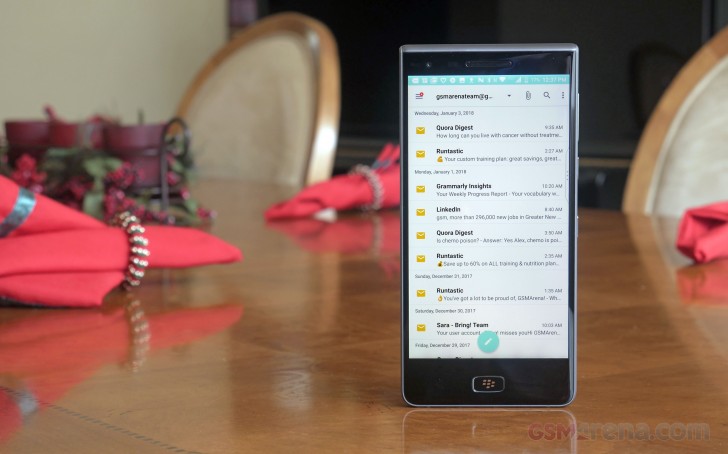
The colors on the BlackBerry Motion are very similar to those on the BlackBerry KEYone: slightly oversaturated for maximum viewing pleasure. The display yielded an average deltaE of 5.6 while the max deltaE was found in one of the shades of gray. The display has a maximum brightness of 393 nits under manual adjustment, meanwhile, that number jumps up to a maximum of 514 nits with adaptive brightness enabled.
| Display test | 100% brightness | ||
| Black, cd/m2 | White, cd/m2 | ||
| 0.463 | 670 | 1448 | |
| 0 | 647 | ∞ | |
| 0.468 | 640 | 1368 | |
| 0.00 | 625 | ∞ | |
| 0.321 | 579 | 1804 | |
| 0.399 | 566 | 1419 | |
| 0.397 | 554 | 1395 | |
| 0.456 | 514 | 1128 | |
| 0.266 | 467 | 1756 | |
| 0 | 437 | ∞ | |
| 0.297 | 431 | 1451 | |
| 0.00 | 422 | ∞ | |
| 0 | 420 | ∞ | |
| 0 | 412 | ∞ | |
| 0.345 | 393 | 1140 | |
| 0.02 | 377 | 25133 | |
Out of its box, this display is tuned very cool. Whites have a blu-ish tone while colors appear to be slightly oversaturated. Unfortunately for those who like to tweak photos, there is no adjustment for tuning the display aside from a color temperature slider.


Color temperature slider
Sliding it "cooler" doesn't make it look any better, but sliding it all the way to the "warm" setting yielded a lower deltaE of 5.1. Doing this brought the display some degree closer to accuracy, though it could certainly be even warmer and still more accurate.
Finally, because of the relatively average maximum brightness, the Motion scored an unimpressive sunlight contrast in our tests.
Sunlight contrast ratio
-
Apple iPhone X
5.013 -
OnePlus 5T
4.789 -
Samsung Galaxy S8
4.768 -
Samsung Galaxy S8+
4.658 -
Samsung Galaxy S6 edge+
4.615 -
Motorola Moto Z2 Play
4.459 -
Oppo R11
4.454 -
Samsung Galaxy S7 edge
4.439 -
OnePlus 3
4.424 -
Samsung Galaxy S7
4.376 -
HTC One A9
4.274 -
Samsung Galaxy Note7
4.247 -
Samsung Galaxy A3
4.241 -
Nokia 8
4.239 -
Google Pixel 2 XL (pre-update)
4.234 -
OnePlus 3T
4.232 -
Google Pixel XL
4.164 -
ZTE Axon 7
4.154 -
Samsung Galaxy Note8
4.148 -
Meizu Pro 7 Plus
4.147 -
Samsung Galaxy S6 edge
4.124 -
Samsung Galaxy A7 (2017)
4.124 -
Huawei Mate 10 Pro (normal)
4.096 -
Samsung Galaxy Note5
4.09 -
Google Pixel 2 (pre-update)
4.023 -
LG V30
4.022 -
Huawei Nexus 6P
4.019 -
Samsung Galaxy J7 Pro
3.998 -
OnePlus X
3.983 -
Vivo Xplay5 Elite
3.983 -
Apple iPhone 7
3.964 -
Oppo R7s
3.964 -
Apple iPhone 8 (True Tone)
3.957 -
Huawei P9 Plus
3.956 -
Meizu Pro 6 Plus
3.935 -
Lenovo Moto Z
3.931 -
Samsung Galaxy A7 (2016)
3.918 -
OnePlus 5
3.914 -
Samsung Galaxy C5
3.911 -
Samsung Galaxy C7
3.896 -
Samsung Galaxy A5
3.895 -
Samsung Galaxy J7 outdoor
3.879 -
Samsung Galaxy J2 outdoor
3.873 -
Samsung Galaxy A8
3.859 -
Samsung Galaxy A8 (2018)
3.842 -
Sony Xperia XZs
3.818 -
Samsung Galaxy A9 (2016)
3.817 -
Motorola Moto X (2014)
3.816 -
Samsung Galaxy J7 (2017)
3.812 -
Samsung Galaxy A5 (2017)
3.804 -
Samsung Galaxy J7 (2016) outdoor mode
3.802 -
Xiaomi Redmi Pro
3.798 -
LG V20 Max auto
3.798 -
Sony Xperia XZ
3.795 -
Samsung Galaxy A5 (2016)
3.789 -
Apple iPhone 6s
3.783 -
Meizu Pro 5
3.781 -
Microsoft Lumia 650
3.772 -
Xiaomi Mi 6
3.767 -
Sony Xperia XZ1
3.765 -
Samsung Galaxy J7 (2016)
3.756 -
Sony Xperia XZ1 Compact
3.729 -
Apple iPhone 8 Plus (True Tone)
3.725 -
Oppo F1 Plus
3.709 -
Vivo X5Pro
3.706 -
Samsung Galaxy A3 (2017)
3.688 -
Apple iPhone SE
3.681 -
Huawei Mate 9
3.68 -
Samsung Galaxy A7
3.679 -
Meizu PRO 6
3.659 -
BlackBerry Priv
3.645 -
Sony Xperia XA1 Ultra
3.597 -
Apple iPhone 7 Plus
3.588 -
LG G6
3.556 -
Apple iPhone 6s Plus
3.53 -
Motorola Moto Z Play
3.526 -
Samsung Galaxy J3 (2016)
3.523 -
Samsung Galaxy J3 (2016) outdoor mode
3.523 -
Acer Jade Primo
3.521 -
Microsoft Lumia 950
3.512 -
Oppo R7 Plus
3.499 -
nubia Z11
3.466 -
Huawei P10 Plus
3.456 -
HTC U Ultra
3.453 -
Samsung Galaxy J7
3.422 -
Meizu MX5
3.416 -
LG V20
3.402 -
Huawei P10
3.379 -
Samsung Galaxy J5 (2016)
3.378 -
Oppo R9s
3.352 -
Honor 8 Pro
3.341 -
Oppo R7
3.32 -
Lenovo P2
3.316 -
Archos Diamond Omega
3.305 -
Honor 9
3.289 -
Xiaomi Mi 5s
3.276 -
Nokia 5
3.261 -
Nokia 6 (Chinese version)
3.244 -
Nokia 6 (Global version)
3.238 -
Samsung Galaxy J2
3.235 -
Sony Xperia X Performance
3.234 -
Xiaomi Mi Note 2
3.228 -
Motorola Moto X Play
3.222 -
Oppo F3 Plus
3.218 -
Huawei Mate 9 Pro
3.206 -
Huawei P9
3.195 -
Xiaomi Mi Mix 2
3.19 -
ZTE Nubia Z17
3.159 -
Oppo R11s
3.153 -
Lenovo Vibe Shot
3.113 -
HTC U11 Life
3.108 -
Motorola Moto X Force
3.105 -
LG Nexus 5X
3.092 -
HTC U11
3.089 -
Huawei Mate S
3.073 -
Microsoft Lumia 640 XL
3.065 -
Motorola Moto X4
3.012 -
Sony Xperia XA1
3.012 -
Sony Xperia L1
2.994 -
Sony Xperia X
2.989 -
LG Q6
2.987 -
Huawei P10 Lite
2.974 -
Samsung Galaxy Note
2.97 -
Sony Xperia Z1
2.95 -
Huawei Mate 8
2.949 -
Xiaomi Redmi 4
2.92 -
Xiaomi Redmi 3S
2.913 -
Sony Xperia XA Ultra
2.906 -
LG G5
2.905 -
Xiaomi Redmi 3s Prime
2.893 -
Xiaomi Mi 5s Plus
2.884 -
Sony Xperia XZ Premium (sRGB)
2.877 -
Sony Xperia XZ Premium
2.877 -
Sony Xperia Z5
2.876 -
Nokia 3
2.871 -
Microsoft Lumia 550
2.851 -
Lenovo Moto M
2.813 -
Xiaomi Redmi 3 Pro
2.803 -
Sony Xperia Z5 compact
2.784 -
Nokia 2
2.752 -
Meizu MX6
2.751 -
LG V10
2.744 -
Huawei Mate 10 (normal)
2.742 -
Motorola Moto G5S Plus
2.737 -
Xiaomi Redmi 3
2.735 -
Huawei Honor 7X
2.734 -
Xiaomi Redmi Note 4 (S625)
2.714 -
Meizu M5
2.71 -
Sony Xperia M5
2.69 -
Xiaomi Mi A1
2.689 -
Xiaomi Redmi 4 Prime
2.679 -
Huawei P9 Lite
2.679 -
vivo V7+
2.671 -
Vivo V3Max
2.659 -
Xiaomi Mi Mix
2.658 -
Huawei Mate 10 Lite
2.654 -
Oppo F5
2.653 -
Doogee Mix
2.642 -
Xiaomi Mi 4i
2.641 -
Xiaomi Redmi 4a
2.635 -
Xiaomi Mi 5X (Standard)
2.616 -
Sony Xperia XA
2.609 -
Motorola Moto G4 Plus (max auto)
2.582 -
Motorola Moto G4 Plus
2.582 -
Meizu M5s
2.58 -
Xiaomi Mi 4c
2.574 -
LeEco Le Max 2
2.567 -
Asus Zenfone 3 ZE552KL
2.563 -
Microsoft Lumia 640
2.563 -
Xiaomi Mi Max 2
2.561 -
HTC U11+
2.556 -
Lenovo K6 Note
2.544 -
Lenovo Moto G4
2.544 -
Oppo F1
2.528 -
Sony Xperia Z5 Premium
2.525 -
Huawei Honor 7 Lite / Honor 5c
2.506 -
Sony Xperia M4 Aqua
2.503 -
BlackBerry Motion
2.494 -
Oppo F1s
2.481 -
Motorola Moto G
2.477 -
Lenovo Vibe K5 Plus
2.473 -
Huawei G8
2.471 -
Huawei nova
2.467 -
Sony Xperia Z
2.462 -
Lenovo Vibe K5
2.459 -
Meizu m3 max
2.447 -
Xiaomi Mi 5X (Auto)
2.417 -
HTC 10 evo
2.407 -
Huawei Honor 7
2.406 -
Vivo V7
2.404 -
Sony Xperia E5
2.386 -
ZUK Z1 by Lenovo
2.382 -
HTC 10
2.378 -
Oppo F3
2.376 -
vivo V5 Plus
2.371 -
Meizu m1 note
2.362 -
Huawei nova plus
2.329 -
Razer Phone
2.328 -
HTC One E9+
2.305 -
Alcatel One Touch Hero
2.272 -
Apple iPhone 4S
2.269 -
Lenovo Vibe K4 Note
2.254 -
Sony Xperia C5 Ultra
2.253 -
Xiaomi Redmi Note 3 (MediaTek)
2.249 -
Sony Xperia C4 Dual
2.235 -
Xiaomi Mi Note
2.234 -
Motorola Moto G (2014)
2.233 -
Huawei P8
2.196 -
Meizu M5 Note
2.189 -
Huawei Honor 6
2.169 -
Xiaomi Redmi Note 2
2.166 -
OnePlus Two
2.165 -
HTC One X
2.158 -
LG Aka
2.145 -
Xiaomi Redmi Note 4 (X20)
2.145 -
Archos 50 Diamond
2.134 -
Xiaomi Redmi Note
2.119 -
Xiaomi Mi 4S
2.095 -
Acer Liquid X2
2.084 -
Huawei P8lite
2.078 -
vivo V5
2.059 -
Moto G 3rd gen max manual
2.026 -
Xiaomi Mi 3
2.001 -
Xiaomi Mi Max
1.996 -
Sony Xperia E4g
1.972 -
OnePlus One
1.961 -
Meizu m3 note
1.923 -
Meizu m2 note
1.892 -
BlackBerry Leap
1.892 -
HTC Butterfly
1.873 -
Sony Xperia Z1 Compact
1.772 -
ZTE Nubia Z9 mini
1.759 -
Sony Xperia U
1.758 -
Asus Zenfone Selfie
1.68 -
Motorola Moto E (2nd Gen)
1.675 -
ZTE Nubia Z9
1.659 -
Jolla Jolla
1.605 -
Motorola Moto E
1.545 -
Sony Xperia M
1.473 -
Sony Xperia L
1.351 -
HTC Desire C
1.3 -
Meizu MX
1.221 -
Sony Xperia E
1.215
Connectivity
Like the KEYone before it, the BlackBerry Motion is powered by the Qualcomm Snapdragon 625. This means it's quite versatile when it comes to network connectivity thanks to its quad-band GSM model. The Motion is capable of LTE-Advanced with theoretical download speeds of 450 Mbps with upload speeds of 50 Mbps.
There are five variants of the BlackBerry Motion listed on BlackBerry's website. There's a single SIM model for EMEA and Asia Pacific (BBD100-1), a single SIM for North America and Latin America (BBD100-2), a CDMA Sprint model (BBD100-3), a model for greater China (BBD100-5) and a dualSIM model for international markets (BBD100-6).
At the time this writing, the BlackBerry Motion has just been announced for availability in the States as GSM Unlocked.
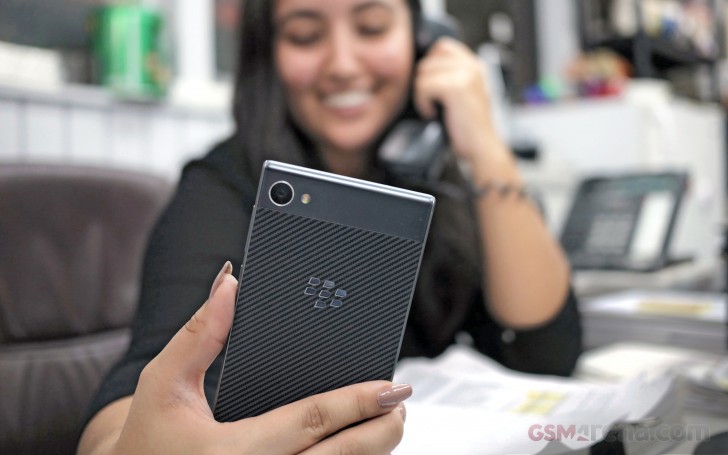
The Motion also supports 2.4 GHz (b/g/n) and 5 GHz (ac) Wi-Fi. You'll also get Bluetooth 4.2 (supporting A2DP, EDR, and Bluetooth LE), NFC (for mobile payments, Android Beam, or quick pairing), and Wi-Fi Direct for faster data connection between Android devices. For global positioning, the Motion supports A-GPS, GLONASS, and BDS2. Unlike the KEYone, the BlackBerry Motion does not have support for FM Radio.
There is a 3.5mm headphone jack on this device and the phone is compatible with Qualcomm Quick Charge 3.0 via the USB-C port. Speaking of which, this port supports OTG and is rated for data transfers on the USB 2.0 standard - no USB 3.0 here.
Battery Life
The BlackBerry Motion has the largest battery capacity of any BlackBerry before it - there's a 4,000 mAh power pack sealed-in. The BlackBerry KEYone had a smaller 3,505 mAh battery, but it also had a smaller 4.5-inch display with a 3:2 aspect ratio. We are expecting that the BlackBerry Motion fares better in our battery endurance tests than the KEYone did.
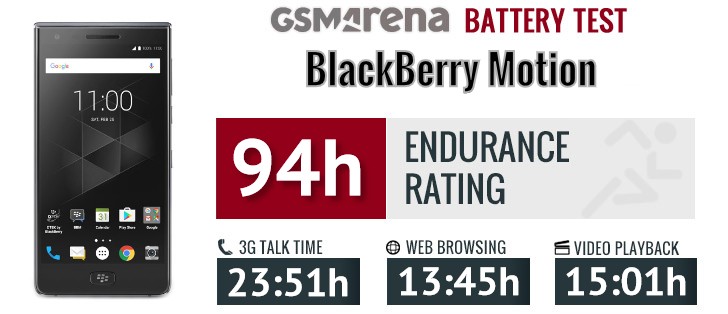
The BlackBerry Motion scored a very good rating of 94h. There's a talk time of 23:51h, a web browsing score of 13:45, and a video playback score of 15:01h. The Motion scored better than the BlackBerry KEYone consistently, thanks to its generously sized battery. Still, we feel that the phone should have done better in our standby tests. It yielded around 280h but we think it could have pushed much farther past the 300h mark with this type of hardware.
The Motion supports the Quick Charge 3.0 charging standard. The included charger caps at 15W (9V @ 1.67A) and brought the Motion from 0% to 26% in 30 minutes of charging. One hour later, it reached 55%. Some competitors are able to reach 50% or so in half an hour so the charging speed is largely unspectacular.
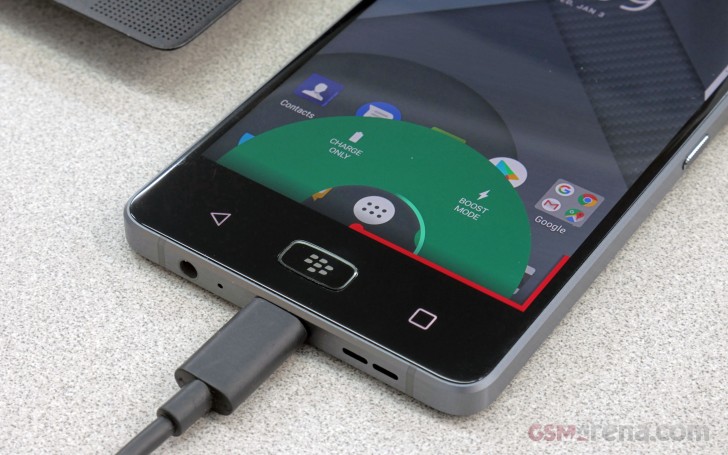
The BlackBerry Motion features a "Boost mode" for charging the battery. Upon plugging in the phone, you'll be presented with a couple of options: 'Charge only' or 'Boost mode'. Everyone knows you can switch any phone to airplane mode to let it charge a bit quicker. You can use Boost Mode when you've got a very limited time to charge the Motion - this will reduce processing power and turn off animations to maximize the amount of capacity recharged while making sure that you don't miss any calls or messages.


Boost mode: prompt • Settings
The same Power Center app that we saw on the KEYone is also here on the Motion. At its most basic, the Power Center app gives you recommendations on which settings to adjust for optimal battery life, and it can notify you if a specific app is hogging battery resources.
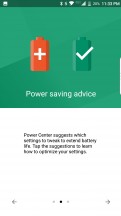
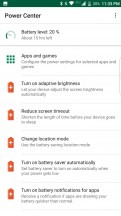
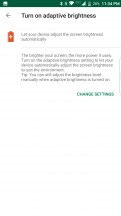
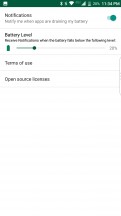
Power Center: Introduction • Recommendations • Suggestion • Settings
Actually getting apps to save you some power under active usage is a bit more of an involved process. Unlike other phones that notify you when an app is draining precious battery life, BlackBerry's Power Center doesn't quite work like that. You have to manually set up the apps that you want to save battery. There are three saving profiles: Performance, Balanced, and Energy Saving.
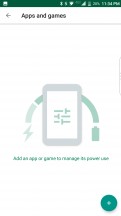
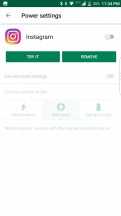
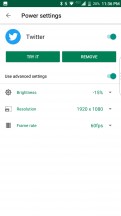
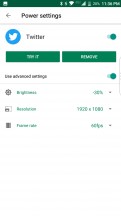
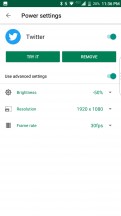
Adding an app • Power saving profiles • Performance • Balanced • Energy Saving
You can also set each power saving option for apps manually. You have the choice of adjusting the brightness, rendering resolution, and even the frame rate. We would advise you test out the settings before you set them for good. We say this because adjusting Instagram's resolution rendered it unusable.

Instagram with resolution change = fail


Tip us
2.1m 180k
RSS
EV
Merch
Log in I forgot my password Sign up