Motorola Razr+ 2025 review
Vanilla and Ultra in one
The Razr+ 2025's displays are one of the areas where the phone does an obvious balancing act between the 'entry-level' Razr and the Ultra. The Razr 2025 is the good enough option, the Razr Ultra 2025 is the best they've got, the plus is somewhere inbetween.
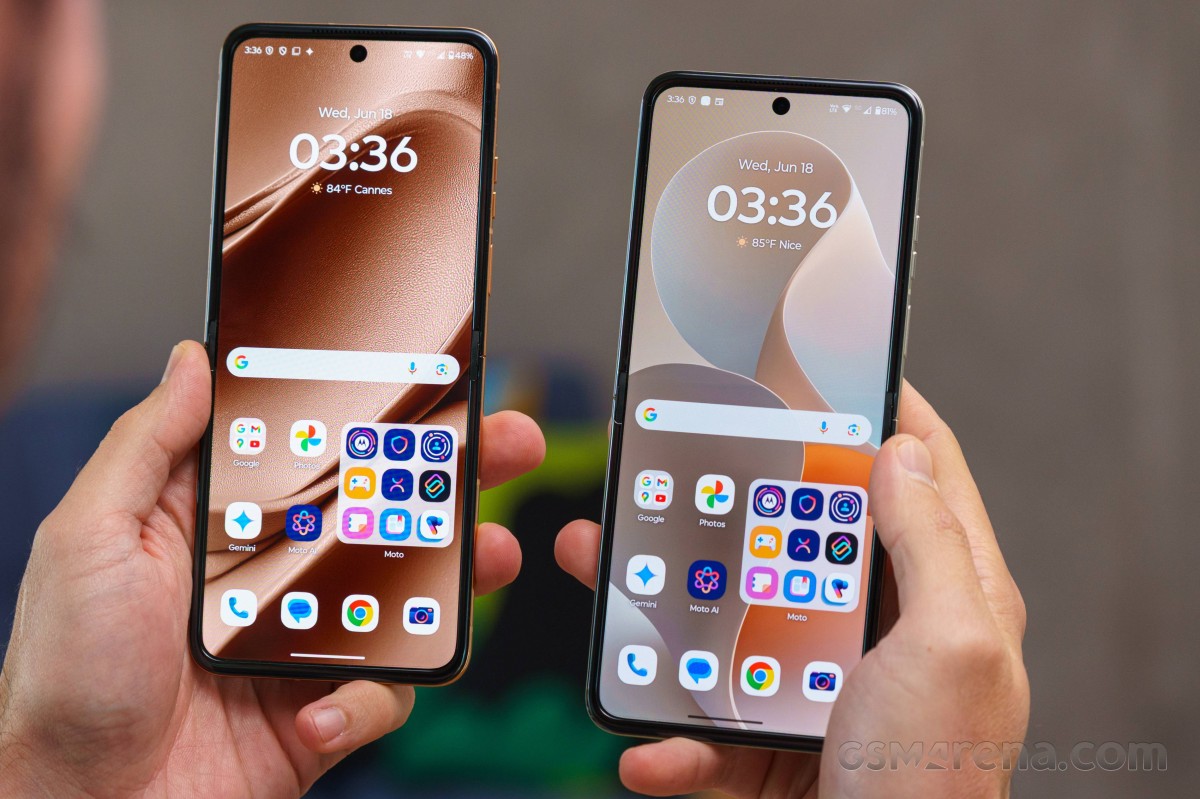 Razr+ 2025 (left) next to Razr 2025
The main display is in many ways like the one on the non-plus - 6.9-inch LTPO OLED with a 1,080x2,640px resolution in a tallish 22:9 aspect. But it also resembles the Ultra's in a couple of aspects - it's got a 165Hz refresh rate and Dolby Vision compliance.
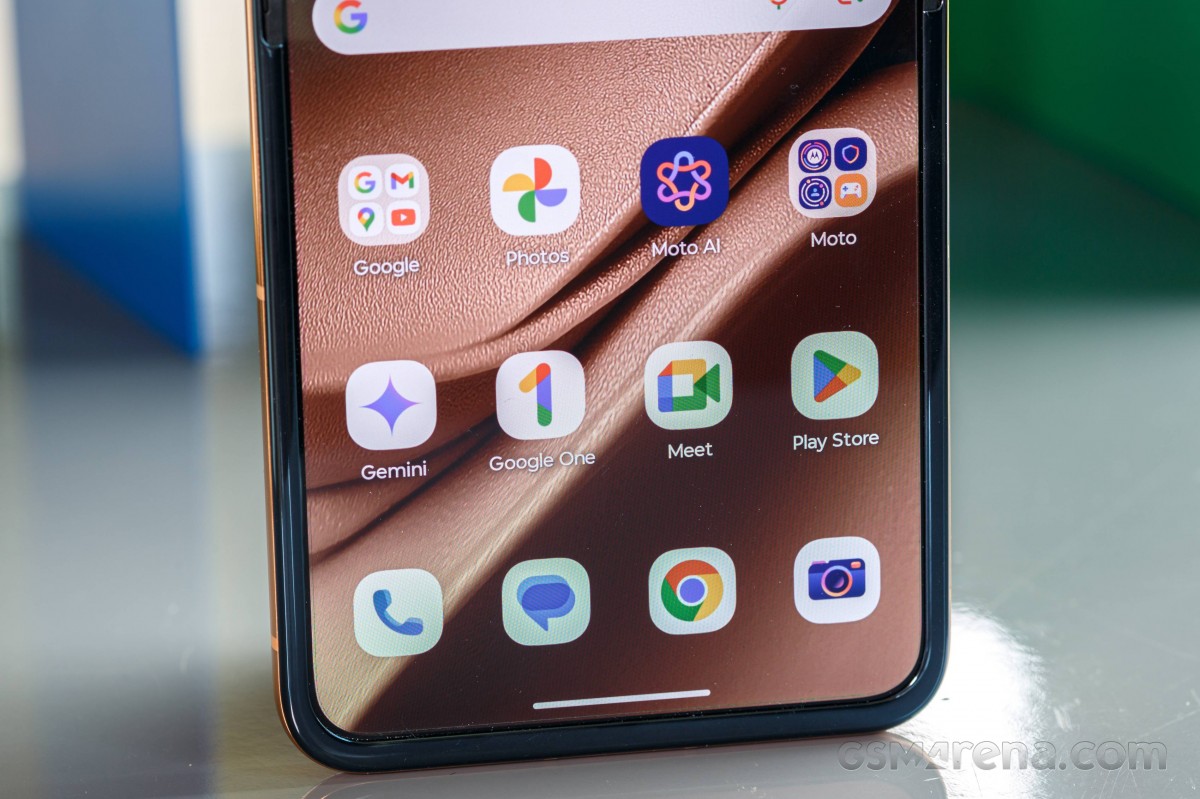
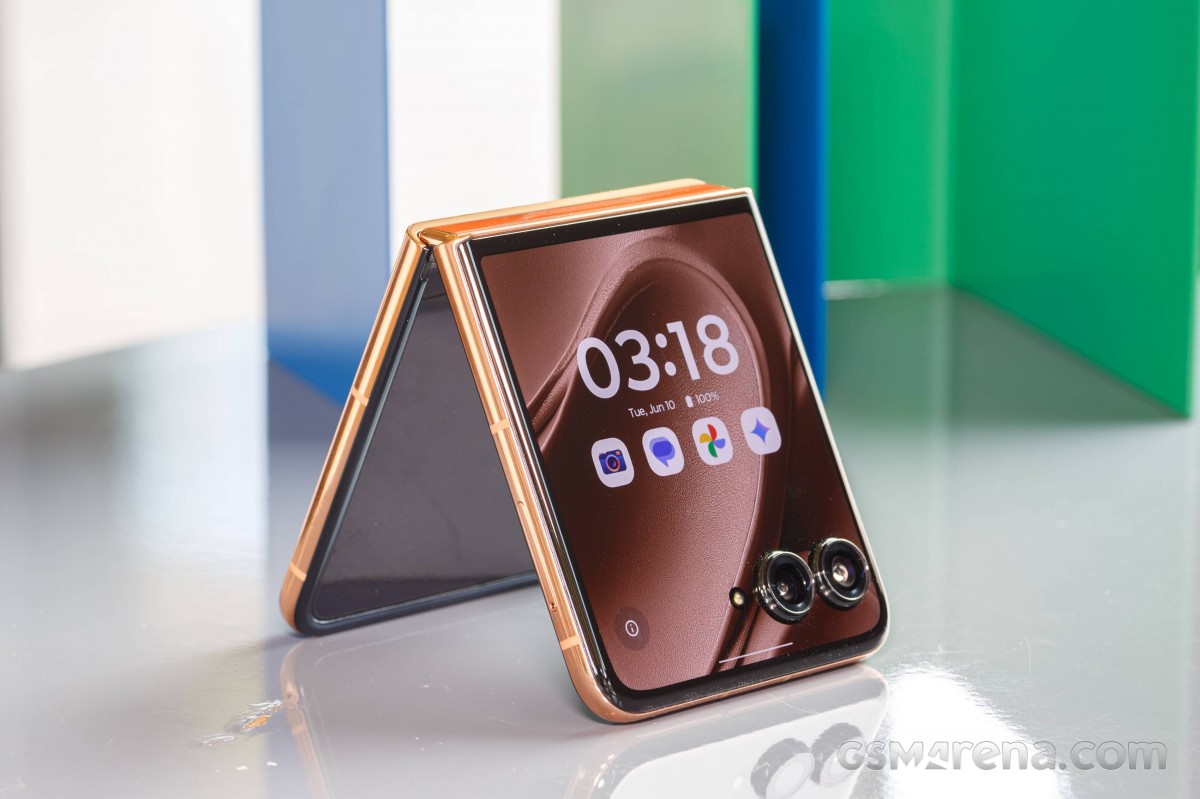
On the cover, things are almost entirely Ultra-grade. Yоu get the 4-inch panel diagonal, the same 165Hz refresh rate (LTPO panel too), and Dolby Vision too - on the Razr 2025 you'll have to make do with 3.6 inches, 90Hz, and HDR10.
In our testing, the Razr+ 2025's foldable panel was good for a little over 1,200nits when placed in bright ambient conditions - roughly on par with the vanilla model, but a couple hundred nits below the results of the Ultra and the Galaxy Z Flip6. The Flip is also noticeably brighter in manual operation, where the Razrs are around the 500-nit mark.
Max display brightness test
White test pattern, 75% fill (nits)
- Manual mode
- Auto mode
 Pixel 9 Pro
 Motorola Razr 60 Ultra
 Galaxy Z Flip6
 Galaxy S25
 Motorola Razr 50 Ultra
 Motorola Razr+ 2025
 Motorola Razr 2025
Similarly, the Razr+ 2025 and Razr 2025 hover in the 1,200-nit ballpark on the cover display, with the Ultra being capable of 300nits more. It's hardly consequential, but it's a difference alright.
Max display brightness test
White test pattern, 75% fill (nits)
- Manual mode
- Auto mode
Motorola Razr 60 Ultra (Cover display)
Motorola Razr 50 Ultra (Cover display)
Motorola Razr 2025 (Cover display)
Motorola Razr+ 2025 (Cover display)
Refresh rate
There are two Refresh modes on the Razr+ 2025 - High (up to 165Hz) and Standard (up to 60Hz). Both act as ceilings, and the phone will pick a refresh rate up to that ceiling depending on content, and it will go down to 1Hz when idling.
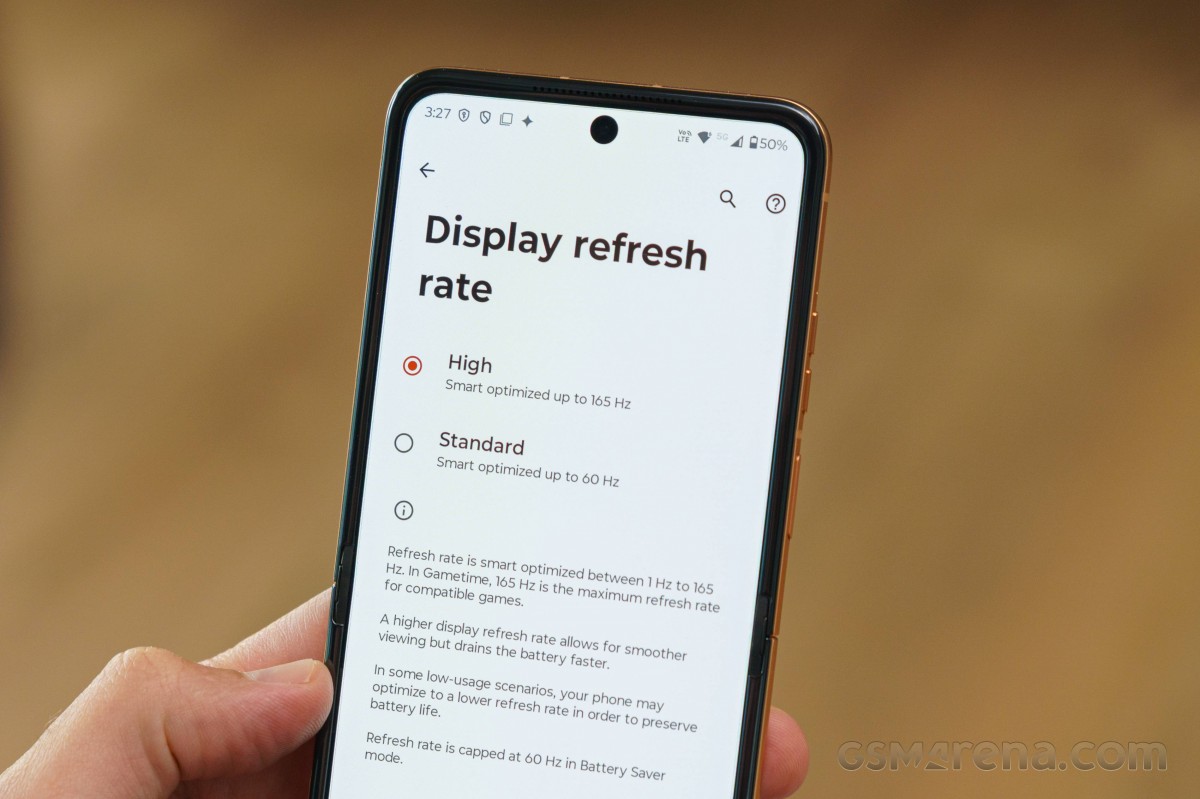
In practice, we could force the 165Hz refresh rate only in games through the gaming utility - there doesn't appear to be another way. That said, the phone would happily maintain 120Hz on its own without user input - in games, certainly, but also in general operation. Videos seemed to get 60Hz regardless of frame rate, but we didn't experience hiccups with 24fps or 48fps content.
Streaming and HDR
The Razr+ 2025 supports Dolby Vision as well as HDR10 and HDR10+, and there's also Widevine L1 compliance for high-res playback of DRM-protected content.
HDR didn't work in Netflix, but it did in YouTube, so long as you have your HDR video in full-screen mode - no windowed HDR playback is possible, which is the same limitation we experienced on the non-plus.
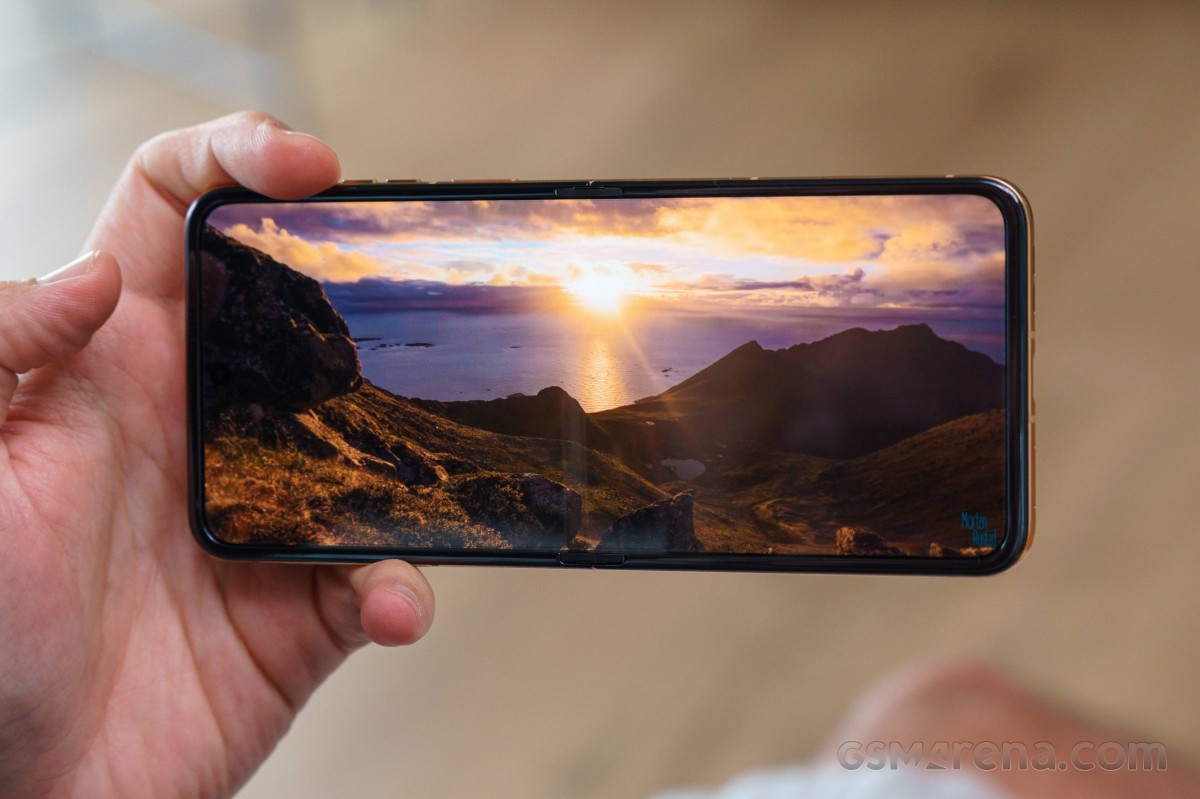
The Android Ultra HDR photo standard is fully implemented, and the Razr+ 2025 will deliver that brightness boost in Google Photos and Google Chrome for compatible images taken on this Razr, or other compliant devices.
Motorola Razr+ 2025 battery life
The Razr+ 2025 runs on a 4,000mAh capacity battery, which sounds like very little in 2025. It's less than the Razr 2025's capacity (4,500mAh), and less than what Ultra has (4,700mAh), though it's a match for the Galaxy Z Flip6.
Update, 6 Jan 2026: We've updated the call test result below after discovering the original lower-than-usual result was caused by excessive location polling by our test automation software. We retested the Motorola Razr+ 2025 with the fix applied and saw an improvement in the call test runtime. The chart below reflects our latest test findings.
In our testing, the Razr+ 2025 acted a lot like the non-plus in the sense that it didn't quite meet our expectations for longevity. Even so, the plus did outlast its less expensive stablemate, despite the vanilla model having a smaller battery and weaker chipset, so we can count that as a win for the plus. The Z Flip6 is also not better than the Moto, though conventional models like the iPhone 16 Pro and even the Pixel 9 Pro will have it beat in an endurance race.
Our new Active Use Score is an estimate of how long the battery will last if you use the device with a mix of all four test activities. You can adjust the calculation based on your usage pattern using the sliders below. You can read about our current battery life testing procedure here. For a comprehensive list of all tested devices so far, head this way.
Charging speed
The Razr+ 2025 is rated for 45W charging, which is higher than the Razr 2025's 30W capability, but not as high as the Razr Ultra 2025's 68W spec. Either way, since the phone ships without a charger, we tested with Motorola's own 68W unit, as well as a third-party 100W Power Delivery brick and got essentially the same results.
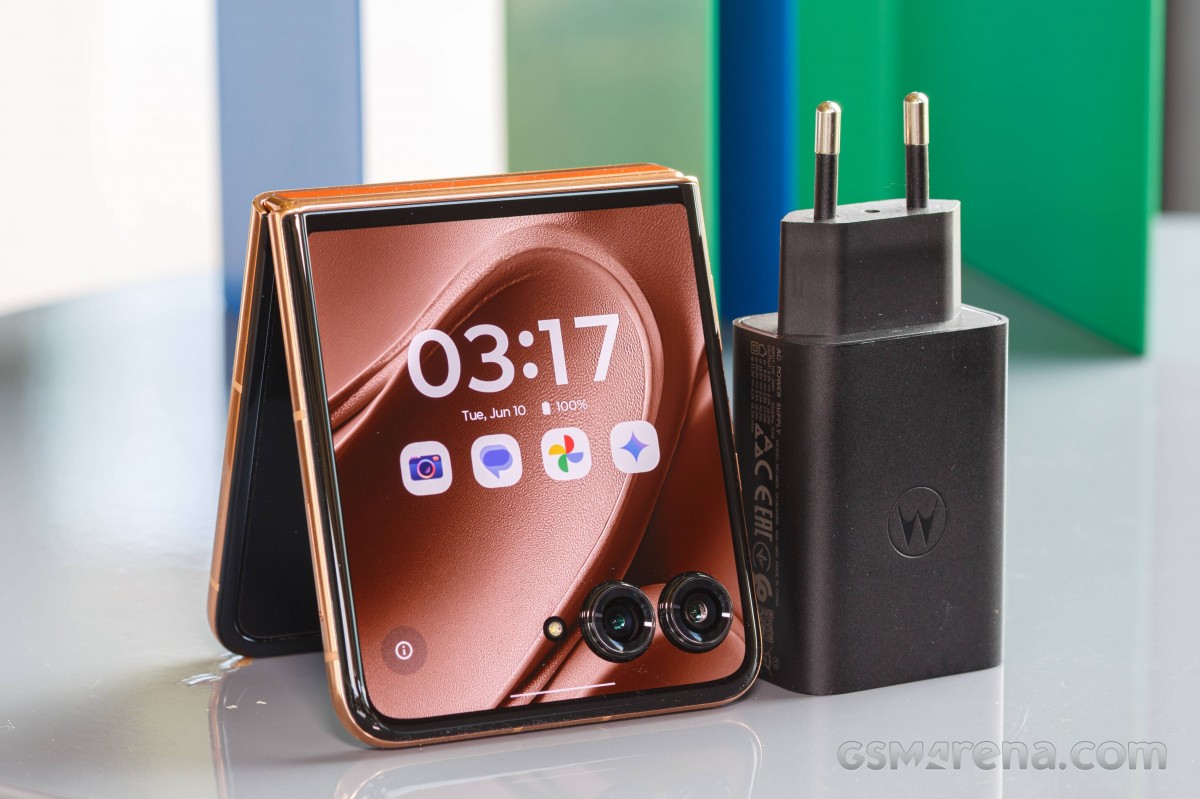
It took us 49 minutes to get from 1% to 100%, and we were looking at 73% in the battery indicator at the half-hour checkpoint. It took about 11-13min after the phone reported 100% before it actually stopped charging, and both chargers peaked at around 36-37W.
Charging speed
- in 15 min
- in 30 min
- Time to full charge (from 0%)
Motorola Razr 50 Ultra
Motorola Razr 60 Ultra
Motorola Razr+ 2025
Motorola Razr 2025
 iPhone 16 Pro
Pixel 9 Pro
Galaxy Z Flip6
The Razr+ 2025 supports wireless charging up to 15W - so too does the Razr 2025, while the Ultra is rated for 30W.
Some of the usual battery health features are on board as well. You can set an 80% hard limit on the charging level if you happen to keep the handset plugged in constantly for days on end.
There's also 'Optimised charging' that will only top off the battery just before the time you typically unplug the phone from the charger, so that it spends as little time at 100% as possible.
There's no apparent way to disable the fast charging (or rather slow it down a little) like some other Motos have in their settings.
Speaker test
You'll find what is now a fairly standard stereo speaker system in the Razr+ 2025 - there's one bottom-firing unit and another one up top that's also the earpiece. The Razr maintains strict channel separation, and it will also adjust which speaker gets which channel based on the handset's orientation in space.
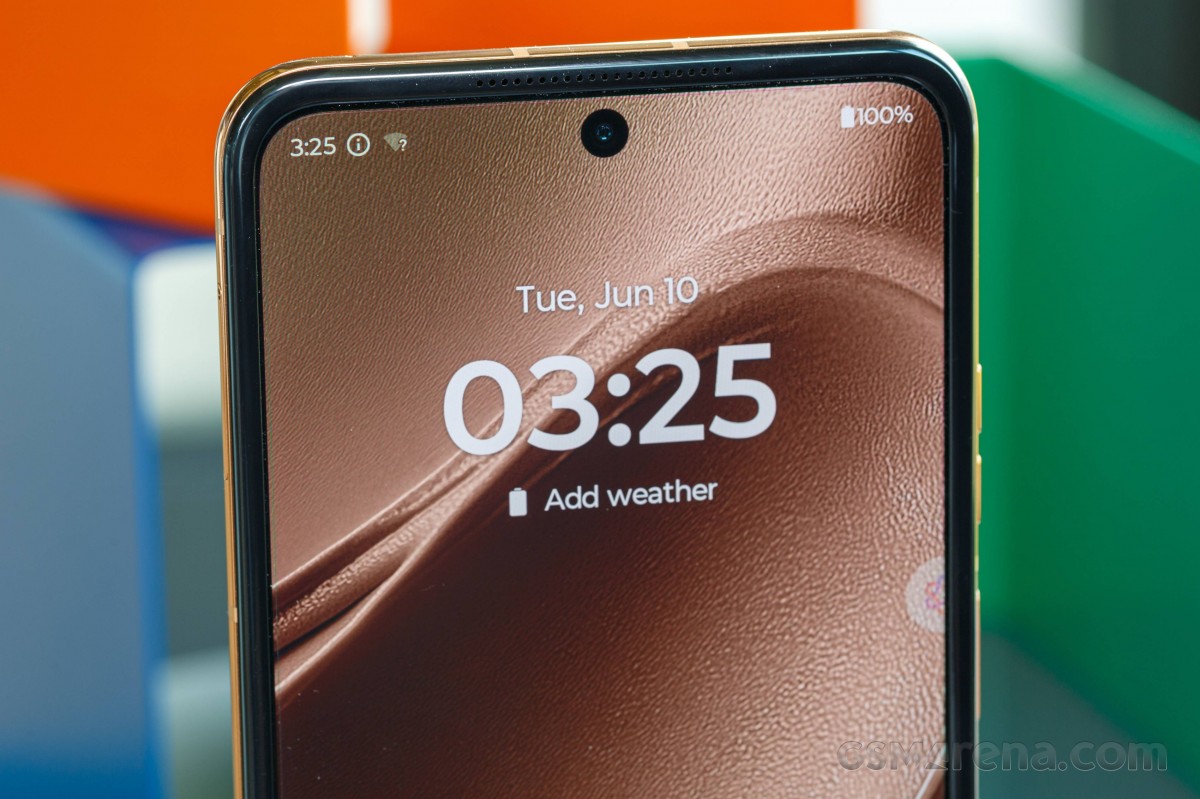 The earpiece is also the top speaker (there's another one on the bottom)
The Razr 2025 earned a 'Very Good' rating for loudness in our testing, which is the same result we got out of the Razr 2025 and the Razr 60 Ultra (think of it as the Razr Ultra 2025). The Z Flip6 isn't as loud and neither is the iPhone 16 Pro, according to our test, but the PIxel 9 Pro also falls in the 'Very Good' category.
When it comes to quality, in our book, the Plus is the best sounding of the current crop of Razrs, it's superior to the Galaxy Z Flip6 and the Pixel 9 Pro, and it's about as good as the iPhone 16 Pro. Nice speakers, indeed.
Use the Playback controls to listen to the phone sample recordings (best use headphones). We measure the average loudness of the speakers in LUFS. A lower absolute value means a louder sound. A look at the frequency response chart will tell you how far off the ideal "0db" flat line is the reproduction of the bass, treble, and mid frequencies. You can add more phones to compare how they differ. The scores and ratings are not comparable with our older loudspeaker test. Learn more about how we test here.


Tip us
2.1m 180k
RSS
EV
Merch
Log in I forgot my password Sign up